Physical Address
304 North Cardinal St.
Dorchester Center, MA 02124
Physical Address
304 North Cardinal St.
Dorchester Center, MA 02124

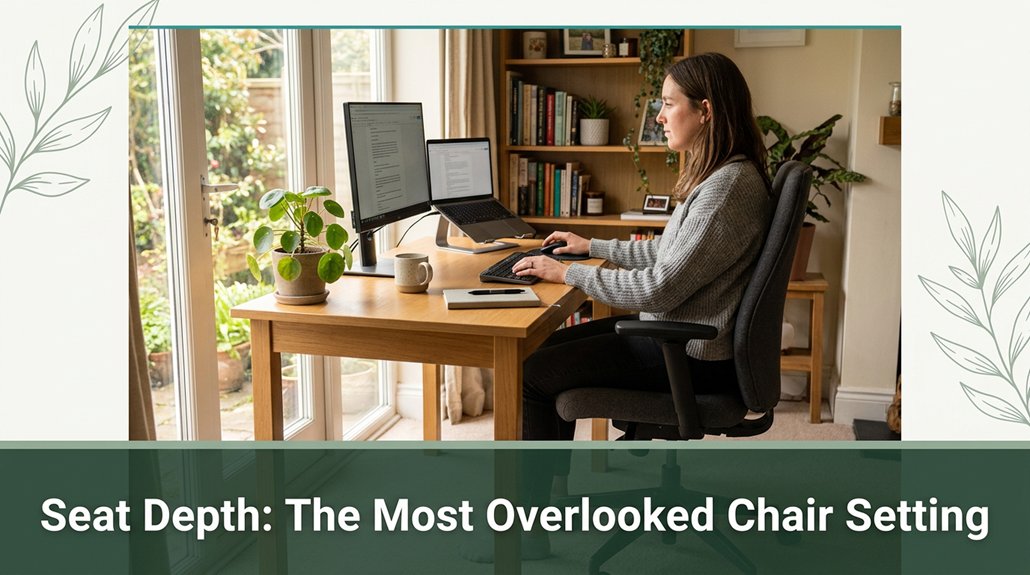
Seat depth might be the most overlooked setting in your chair, but it can secretly sabotage your posture without you realizing it. If it’s too shallow, your thighs don’t get enough support; if it’s too deep, your knees get pinched and circulation gets blocked. Finding that just-right depth is like a Goldilocks moment perfect for keeping your hips and lower back comfortable. Trust me, making this simple adjustment can make a huge difference in how you feel after hours at your desk. Keep reading to learn how to dial in that perfect fit and avoid long-term discomfort.
This article contains affiliate links. If you purchase through them, I may earn a small commission at no extra cost to you. I only recommend products I genuinely believe in.
Seat depth might seem like one of those minor details, but trust me, it’s a game-changer for sitting comfort. When you pick a seat depth office chair that matches your thigh length, you avoid putting unnecessary pressure on your sit bones, which is the part you sit on, and you spread out the weight more evenly.
If the seat is too shallow, your muscles will have to work harder just to stay balanced, which can quickly lead to fatigue. Conversely, if the seat is too long, your knees may be squished, cutting off circulation and causing numbness an experience many people who sit for more than 6 hours a day are familiar with.
According to OSHA ergonomic guidelines, the optimal seat depth allows about 2 to 4 inches (5 to 10 cm) of space between the edge of the seat and the back of your knees. This ensures your thighs are fully supported without pressing behind your knees, which can reduce discomfort and promote better circulation.
Research on spinal biomechanics suggests that correct seat depth can also help maintain healthy lumbar and sacral alignment, reducing the risk of developing lower back issues such as sciatica. Additionally, proper seat depth adjustment enhances overall posture and can prevent musculoskeletal discomfort during long working hours. Properly aligning the seat depth in relation to your body measurements is key to an effective ergonomic setup.
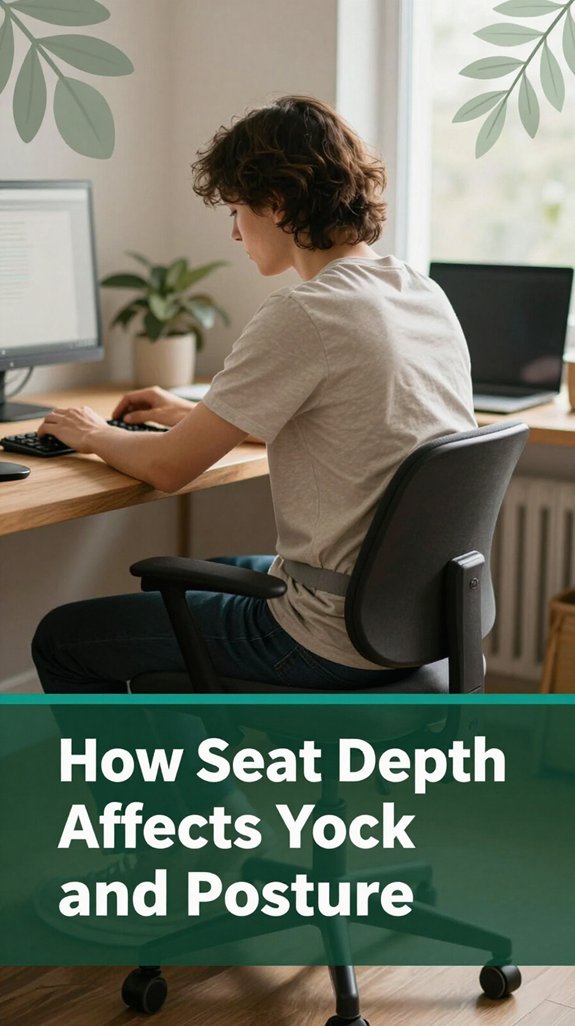
Ever feel like your lower back suddenly aches just because you’ve been sitting too long? According to OSHA ergonomic guidelines, many ergonomists recommend that proper seat design can help prevent this discomfort.
Here’s the deal: seat depth plays a huge role. If it’s too deep, your pelvis tilts backward this is called “perching” which flattens your natural lumbar curvature (the inward curve of your lower back). This position puts extra pressure on your lumbar intervertebral discs and may contribute to lower back pain or conditions like lumbar disc herniation. Proper seat depth helps maintain spinal alignment by supporting the natural S curve of the spine. If your chair’s seat depth is excessive, it can also restrict blood flow to your thighs and hinder circulation, which may lead to fatigue and discomfort over time.
On the other hand, a seat that’s too short leaves your thighs unsupported, which encourages slouching and poor postural alignment. Supporting your full thigh length helps promote a slight forward tilt of your pelvis around 5 to 15 degrees (which encourages an upright, healthy spinal posture) and keeps your lumbar spine in its natural curve. This intentional support can also improve overall postural stability during long periods of sitting.
This alignment reduces the risk of developing thoracic kyphosis or other postural issues over time.
The right seat depth supports your lumbar spine by promoting optimal pelvic tilt and maintaining the natural, lordotic curve of your lumbar spine. It also encourages proper engagement of core muscles that support your back and reduces strain on your thoracic and cervical regions.
Bottom line: proper seat depth is essential for supporting your lower back, maintaining spinal health, and preventing discomfort and long-term musculoskeletal issues during extended periods of sitting.

If you’ve ever sat in a chair and felt that familiar ache creeping into your lower back, you probably suspect the seat mightn’t be quite right.
Here’s how to measure your ideal seat depth without turning it into rocket science:
First, find your *buttock–popliteal length*: sit upright, with your knees at about a 90-degree angle (which helps maintain proper spinal alignment). Measure from the back of your buttocks to the crease behind your knee.
According to ergonomic guidelines from OSHA, this measurement is essential for selecting a supportive seat that accommodates your lower body.
Next, subtract approximately 1.5 to 2 inches (4–5 cm) from that length. This adjustment ensures your thighs are well supported without compression, promoting healthy circulation and reducing pressure on your lumbar spine.
Finally, use a flexible tape or a gentle ruler to measure from the front edge of the seat to the seat-back junction or the backrest. Remember, your goal is to achieve supportive support, avoiding thigh compression or legs dangling unsupported, which can contribute to lumbar strain or sciatica.
Short and sweet: proper seat depth helps maintain spinal health by supporting the lumbar and sacral regions, preventing discomfort during prolonged sitting.

Have you ever noticed how, after sitting for a while, your knees start to feel like they’re doing their own impression of a stretched-out rubber band? If so, your seat might be too deep. When the front edge presses into the back of your knees, it compresses nerves and blood flow, according to OSHA ergonomic guidelines. This compression can cause numbness, tingling, or discomfort and it’s fundamentally asking your legs to go numb or tingle just to get your attention.
A seat that’s too deep presses on your knees, causing numbness and discomfort by restricting blood flow.
You might feel discomfort on the back of your calves or notice your feet feeling cold, which isn’t exactly a warm welcome. Sometimes, your hips slide forward, and your back slouches because your thighs aren’t supported enough. This is often due to the seat depth preventing proper lumbar and thigh support, which can lead to poor spinal alignment.
Judging by research on spinal biomechanics, your body’s trying to find balance your hips and lumbar spine seek proper support indicating that your chair isn’t built for your body.
Proper seat depth can also help maintain proper circulatory health, reducing the risk of numbness or tingling sensations during prolonged sitting.
Essentially, a seat with an appropriate depth around 2 to 4 inches (which allows for about a two-finger gap between the edge of the seat and the back of the knees) can help maintain healthy circulation and spinal alignment.

When it comes to choosing the right seat depth for your chair, one size definitely doesn’t fit all, and that’s according to OSHA ergonomic guidelines. That’s coming from someone who’s experienced sitting too deep and feeling like your thighs are in a constant cramp hold.
Think of it like tailoring a suit: too deep, and you’re risking circulation issues, especially if your seat depth exceeds 95% of your buttock–popliteal length, which can cause discomfort and nerve compression. Too shallow, and your sit bones will bear the majority of the weight, leading to pressure points and potential discomfort in the ischial tuberosities. Proper seat depth also supports overall ergonomic posture by maintaining proper spinal alignment.
Here’s the practical guidance:
Matching the seat depth to your unique body proportions helps maintain healthy lumbar, sacral, and thigh support, reducing the risk of musculoskeletal discomfort. Selecting a seat depth that aligns with your body measurements can significantly enhance overall ergonomic comfort.
Proper seat depth supports spinal alignment and encourages good posture, which can prevent issues such as sciatica, thoracic kyphosis, or lower back pain.
Adjusting your seat depth might seem like a minor tweak, but honestly, it can make a significant difference in how comfortable you feel throughout the day and how well your body maintains proper alignment over time.
First, sit back so your pelvis touches the backrest, with your lumbar spine in a neutral position that is, maintaining the natural inward curve. According to OSHA ergonomic guidelines, this position reduces strain on the lower back and promotes spinal health.
Sit back with pelvis against the backrest and maintain a natural lumbar curve to protect your lower back and support spinal health.
Your feet should be flat on the floor, with your knees roughly at a 90-degree angle. This means your thighs are parallel to the floor, optimizing circulation and reducing pressure on the knees.
Find the adjustment mechanism usually a lever or knob located beneath the seat and gently slide the seat forward or back. Aim for a 2 to 3 finger gap between the front edge of the seat and the back of your knees. This spacing helps prevent pressure on the popliteal fossa, reducing discomfort during prolonged sitting. Proper seat depth also aids in distributing your weight evenly, preventing pressure points that can cause discomfort or numbness.
Test the fit by sitting again. A proper seat depth feels natural and unobstructive, allowing you to sit upright without feeling constricted or overly extended.
Micro-adjust as needed to fine-tune the fit your body will thank you later and help prevent issues like sciatic nerve compression or sacral pressure. Proper seat depth also supports good blood flow, which is crucial for maintaining comfort during extended periods of sitting.
All right, let’s get real you’ve probably noticed that not all chairs are created equal. Fixed seat depth chairs are like that one-size-fits-only-in-the-middle hat. They tend to be set around 17–19 inches, but that just fits average-height people best, according to ergonomic guidelines.
Chair dimensions, including seat depth, significantly influence posture and comfort. A mismatched seat depth can lead to poor circulation and added pressure on the thighs, which can cause discomfort over time.
Now, adjustable chairs are a whole different story. They let you slide the seat forward or back, which means you can customize the fit for your thigh length. This helps eliminate the feeling of being slightly too cramped or overly sprawled, increasing comfort during extended periods of sitting.
Adjustable seats also ensure full backrest contact remains consistent, supporting your lumbar and thoracic spine properly. This is especially important for preventing issues like lumbar strain, sciatic nerve irritation, or thoracic kyphosis.
Additionally, they’re more versatile, particularly in shared workspaces, because different individuals can dial in what’s most comfortable for their body dimensions. Here’s the key: if you want comfort, flexibility matters. Fixed chairs often just try to guess who you are, which can compromise spinal alignment and long-term comfort.
You’ve probably spent a good chunk of your day gently adjusting in your chair, trying to find that sweet spot where your thighs aren’t glued to the seat edge but aren’t floating in space either. Here’s a simple trick: make sure your feet are flat on the floor or on a footrest that’s your stable base.
Your seat height should keep your thighs roughly parallel to the floor, with knees at about 90–100° (which allows for optimal blood circulation and reduces strain on your lower limbs). When your hips are slightly higher than your knees, according to OSHA ergonomic guidelines, blood flow is improved and you avoid pinching behind the knees.
Sit all the way back with your pelvis touching the backrest no slouching! Use the two-finger rule or even a clenched fist to check that your seat depth isn’t pressing into the back of your knees. This measurement helps prevent compression of the popliteal fossa, reducing the risk of sciatic nerve irritation and optimizing circulation.
Proper seat depth fit is especially important because it supports healthy blood flow, preventing discomfort and long-term issues. Ensuring the right ergonomic seating position can make a significant difference in your overall comfort during long hours. Trust me, tiny tweaks make a big difference when it comes to seating comfort. Proper seat depth fit ensures your thighs are fully supported without pressure, which can alleviate discomfort in the hamstrings and lower back over extended periods.
When you’re choosing between a fixed or adjustable seat depth, the key thing to keep in mind is how well the chair fits your body it’s not one-size-fits-all, regardless of what that sleek ad promises.
All right, here’s what you should consider:
Optimizing seat depth for long-term sitting comfort starts with understanding how important it’s to support your thighs without causing pressure points or sacrificing back support. According to OSHA ergonomic guidelines, you want your thighs fully supported but with about 1–2 inches (2.5–5 cm) of clearance behind your knees that prevents compression of blood vessels and nerve impingement, which can cause discomfort or numbness.
Proper seat depth reduces the risk of musculoskeletal disorders by ensuring that your muscles are not forced to stabilize your spine excessively during prolonged sitting. You should avoid sitting with your thighs either compressed against the seat or hanging off the edge, as both positions can lead to discomfort and lower back strain.
Think of adjusting your seat so you can sit upright without feeling perched or being pushed into slouching, maintaining proper spinal alignment. To achieve this, measure your buttock-popliteal length the distance from your sacrum (the lower part of your spine) to the back of your knee. For fixed-seat options, aim for a seat depth around 16.5 inches (about 42 cm), which accommodates typical adult leg lengths. If you have an adjustable seat, a range between 14 and 18.5 inches (35 to 47 cm) generally works well.
Remember, if the seat is too deep, it can cause “perching,” where you’re forced to sit forward or support yourself with your legs, leading to increased load on your lumbar spine and unnecessary back fatigue. Conversely, a seat that’s too shallow will fail to adequately support your thighs, leading to increased pressure on your lower back and hips.
Ensuring that your ergonomic seat adjustment is correct can make a significant difference in comfort and posture over time, reducing the risk of fatigue and injury. Proper seat depth enables your lumbar and sacral regions to be supported correctly while promoting good posture. Making sure the seat depth is just right will help prevent discomfort during prolonged sitting, and your back will thank you for it.
You’ll find that seat depth preferences really vary by ethnicity.
For instance, folks from East and Southeast Asia often prefer shorter, adjustable seat pans because they’ve got shorter thigh lengths and PopL measurements.
Meanwhile, Western and African-descended groups tend to need longer seat pans to support their longer leg segments.
It’s all about matching the chair to your body’s unique proportions because one size definitely doesn’t fit all.
If you use the wrong seat depth, you’re risking more than just discomfort you’re playing with your blood flow and spine health.
Too deep, and your knees press into the soft tissue behind, restricting circulation and risking DVT or numbness.
Too shallow, and you lose thigh support, putting unnecessary pressure on your sit bones and messing with your lumbar alignment.
All right, your body isn’t a one-size-fits-all deal, so adjust accordingly to stay comfortable and healthy.
Yes, adjusting seat depth can definitely boost your leg circulation. When you set it right, you avoid compressing the back of your knees, which helps blood flow freely and keeps those pins-and-needles feelings at bay.
Think of it like giving your legs room to breathe no squishing, no pinching. When your thighs are supported properly and your knees aren’t crammed, circulation improves, and you’ll feel a lot better, even after a long day.
Imagine your chair’s seat depth as a suit tailored just for your body and yes, gender’s like the secret fabric that influences that fit. You, as a taller guy or a shorter gal, need different lengths.
Men often sit with more pelvic tilt lengthening their functional seat need while women, sitting more upright, might feel cramped if the seat’s too deep.
The key: adjust it so you sit comfortably, not like a sardine.
You’re wondering how seat depth helps prevent lower back pain, right? All right, here’s the deal: when your seat’s just right, it supports your lumbar curve and evenly distributes your weight.
If it’s too deep, it can push into the back of your knees, cutting off circulation and causing you to shift awkwardly adding strain.
Proper seat depth keeps your pelvis in a neutral, supported position, reducing disc pressure and easing lower back pain.
All right, after all this, here’s the deal: seat depth isn’t just a fancy feature; it’s the secret sauce to sitting comfortably for the long haul. When you get it right, it’s like your chair becomes a gentle hug, not a torture device. So, measure, adjust, and listen to your back it’s telling you what it needs. Don’t let your chair turn into the villain of your workday. Trust me, your back will thank you.