Physical Address
304 North Cardinal St.
Dorchester Center, MA 02124
Physical Address
304 North Cardinal St.
Dorchester Center, MA 02124

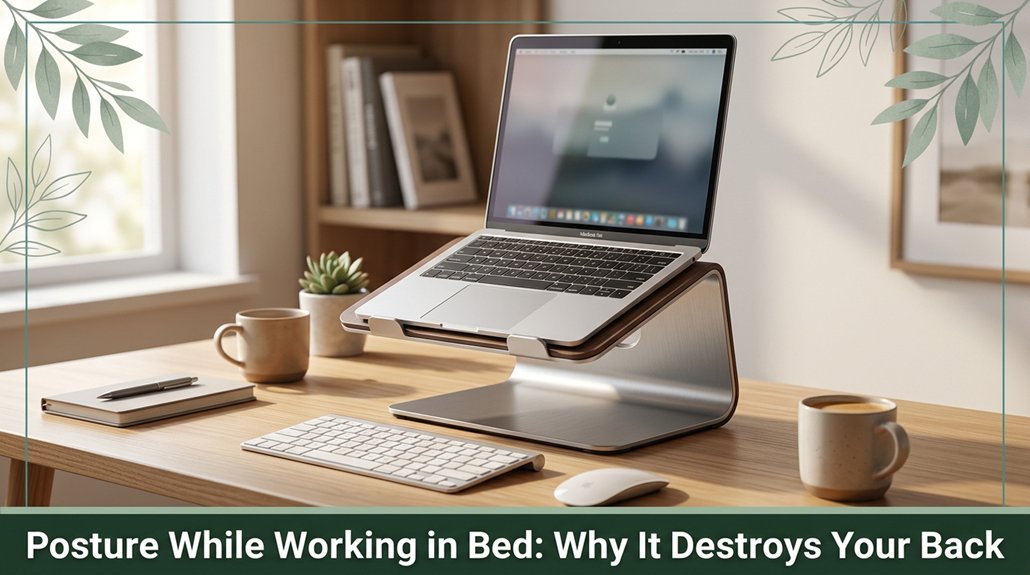
Looking to get some work done in bed without ending up with a sore back? It’s tempting to settle into a comfy mattress, but slouching into that softness can quickly lead to pain. Your spine isn’t meant to bend in those awkward ways, and discs can get squished out of place.
Keep your devices at eye level, support your lower back with pillows, and try to change positions regularly. A little mindful effort now can save you a lot of discomfort later let’s see why setting up properly makes all the difference.
This article contains affiliate links. If you purchase through them, I may earn a small commission at no extra cost to you. I only recommend products I genuinely believe in.
Imagine working in bed and feeling cozy, but your spine’s not exactly on board with the plan. That’s the thing with working in bed posture problems: your soft mattress encourages spinal flexion, which adds pressure to your lumbar discs.
According to research on spinal biomechanics, this is like squeezing a sponge repeatedly. Lack of firm support causes your neck to stay bent for extended periods, stressing the cervical vertebrae. This prolonged bending can accelerate degeneration of cervical discs.
Physical health effects Working from a soft surface can lead to strain on neck, back, and hips. The unstable surface of a bed causes tiny micro-movements, which tire out your core muscles many ergonomists recommend that stable support helps maintain proper spinal alignment.
Slouching on pillows compresses the intervertebral discs in your lumbar, thoracic, and cervical regions, potentially speeding up degenerative changes. This prolonged compression can contribute to chronic back pain. Additionally, reaching for your laptop often causes your shoulders to lift, straining the trapezius muscles.
Over time, this can lead to tension headaches and shoulder discomfort. If you frequently work in bed, your poor posture not only causes immediate discomfort but can also lead to long-term musculoskeletal issues. Incorporating ergonomic seating solutions similar to office chairs can help improve posture and reduce these risks.
All right, let’s talk about what goes wrong when you’re working in bed, and I mean really wrong.
You probably place your laptop on your thighs, forcing your neck to bend beyond 20 degrees (which can strain the cervical discs according to OSHA ergonomic guidelines).
Or maybe you hold your tablet in your hand, lifting your shoulders and overloading your rotator cuff, increasing the risk of shoulder and upper back fatigue.
Then there’s the soft mattress turning your wrists into a pretzel while typing, leading to carpal tunnel syndrome.
Research on spinal biomechanics suggests that wrist angles exceeding 60 degrees during typing can increase nerve pressure.
Wrist angles over 60 degrees during typing can significantly increase nerve pressure and cause discomfort.
Additionally, a lower monitor height that forces you to lean forward causes neck flexion, which can compress cervical discs and exacerbate thoracic kyphosis.
Here’s the thing:
All these mistakes really add up and your back feels every single one.
To minimize discomfort, ensure your devices are positioned at eye level to avoid neck bending, support your lower back with ergonomic cushions, and take regular breaks to stretch and change postures.
Maintaining proper ergonomic habits is essential for preventing musculoskeletal issues when working in bed.
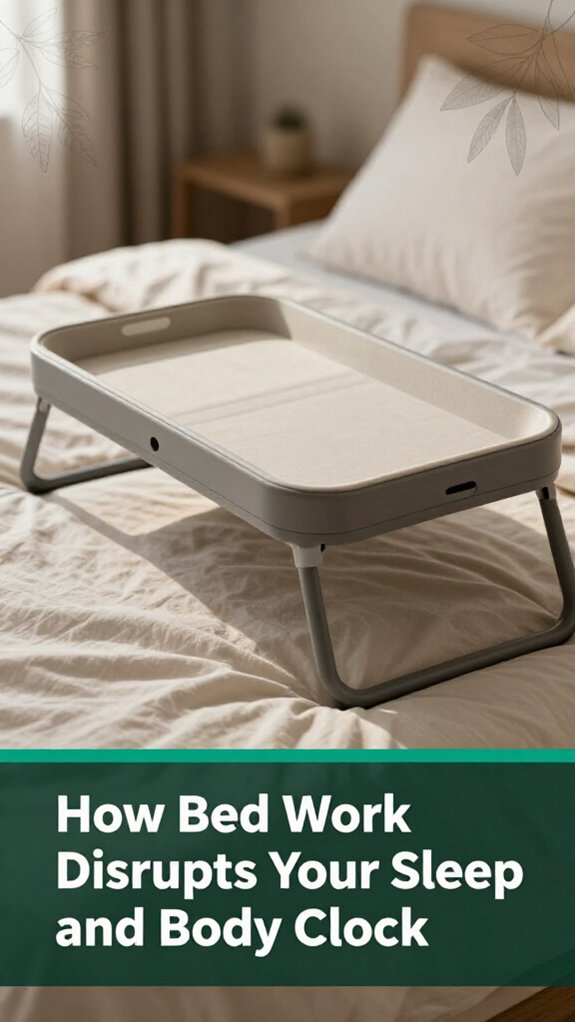
When you work in bed, it’s like your brain gets a little confused: your cozy sleep zone suddenly becomes a job zone. All right, you might think, “It’s just a few hours,” but your brain isn’t quite that simple. Using your bed for work trains your mind to link the two places, so when it’s time to sleep, it’s not sure if you’re resting or stressing.
Research on sleep and circadian rhythms suggests that the brain associates specific environments with particular activities. If you work in bed consistently, your brain may have difficulty distinguishing between wakefulness and sleep, which can lead to sleep onset issues. Studies indicate that working in bed can cause the brain to rewire pathways, making it harder to switch from alertness to relaxation. Plus, blue light emitted from your phone or laptop suppresses melatonin, the hormone responsible for regulating sleep-wake cycles which makes it harder to fall asleep. This suppression can delay sleep onset by 20 to 45 minutes, according to Mayo Clinic recommendations.
Delayed sleep onset and nighttime awakenings are common because your nervous system remains more active when your environment blurs the boundaries between work and rest. As a result, your sleep quality diminishes, and your body’s internal clock, or circadian rhythm, can become disrupted, impacting overall health.
Balancing your sleep and work environment isn’t just about comfort; it’s essential for maintaining a properly functioning body clock. Creating a dedicated workspace away from your bed, along with avoiding blue light exposure hours before sleep, can help your circadian rhythm stay aligned and promote restorative sleep.
All right, you’ve probably noticed that after a few hours of typing on your lap or stretching out flat on your back in bed, your body starts sending signals kind of like an overzealous alarm clock.
Maybe it’s a dull ache in your neck, the tingling sensation in your fingers, or a creak in your hips when you get up.
Dull neck aches, tingling fingers, or creaky hips signaling the need for better posture in bed.
You might feel your head tilting forward past 15 degrees (which can cause neck strain), according to OSHA ergonomic guidelines.
Your upper back may feel rounded from slouching, which research on spinal biomechanics suggests can contribute to thoracic kyphosis.
Or, the next day, your hips might be sore due to tight hip flexors and uneven pressure distribution, especially for people who spend more than 6 hours daily in bed.
Listen up these symptoms are your body’s way of saying it’s time for some posture adjustments before the discomfort worsens.
Maintaining proper cervical spine position, keeping your thoracic spine in a neutral curve, and ensuring even weight distribution can help prevent long-term musculoskeletal issues.
Poor sleep posture can exacerbate these symptoms, making proper alignment even more critical to prevent chronic pain.
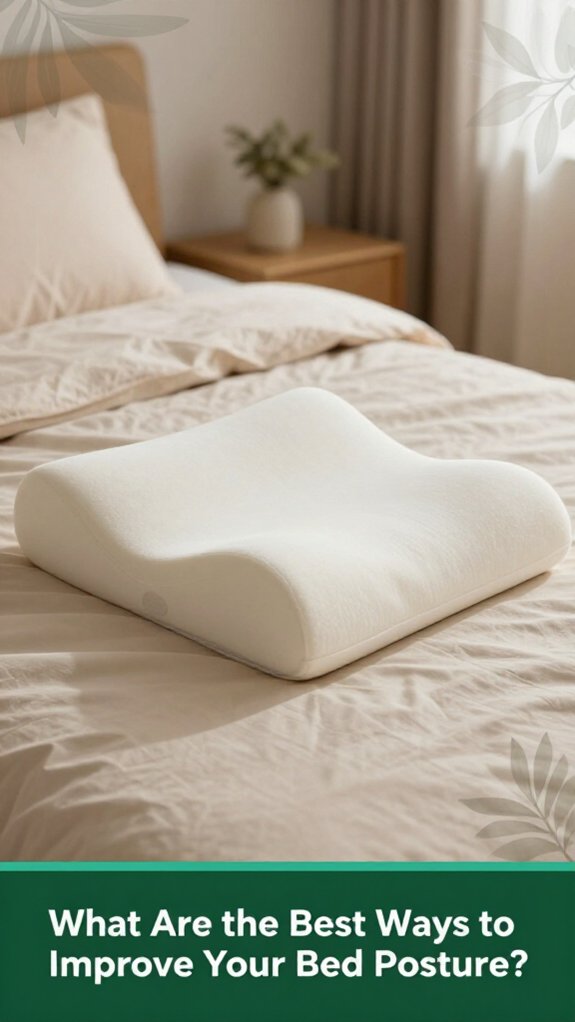
If you’ve ever collapsed into bed after a long day feeling like you’ve just run a marathon without leaving the house, you know how tricky it can be to get your posture right without even realizing it.
First, choose a firm mattress soft ones can cause your spine to bend into unnatural shapes, risking disc issues according to OSHA ergonomic guidelines. A memory-foam topper can help keep your lumbar spine supported, preventing that sinking feeling that may lead to lower back pain or sciatica.
Now, pillows matter too: a vertical pillow placed behind your back supports your lumbar region, helping you maintain the natural inward curve of the lower spine. A knee pillow keeps your legs in a comfortably flexed position many ergonomists recommend a 15-30 degree bend at the knees to reduce strain on your hamstrings and improve spinal alignment. Additionally, understanding proper monitor placement can significantly impact your overall posture during work, even when in bed.
Finally, keep your device at eye level using a stand this prevents neck hyperextension or craning, which can contribute to thoracic kyphosis or neck strain. Proper device positioning can also help reduce eye strain and prevent headaches caused by looking down at screens for extended periods. No more neck craning means less risk of developing cervical issues or tension headaches.
These small adjustments add up to significantly reduce morning discomfort, helping your back feel a lot less ruined come sunrise.
Now that you know how small adjustments at bedtime can make a difference, it’s time to get serious about the tools and positions that keep your spine healthy during those long hours of bed work. Ergonomic tools like laptop stands lift your screen to eye level, reducing neck flexion by up to 30 percent, according to OSHA ergonomic guidelines.
Adjustable lap desks provide a firm surface, preventing you from sinking into the mattress, which forces your lower back to work harder and can contribute to lumbar strain. Foam roll supports help maintain a neutral lumbar curve, decreasing lower-back strain by 40 percent, as research on spinal biomechanics suggests.
Adjustable lap desks and foam roll supports reduce lumbar strain and keep your lower back healthy during bed work.
To promote proper alignment and prevent muscular tension, use lumbar supports and foam rolls. Keep your elbows at a 90-degree angle with armrests to avoid shoulder tension and promote comfortable arm positioning.
Elevate your feet with portable footrests to support a neutral pelvis position, which can help reduce sacral and lumbar strain during prolonged sitting.
For optimal posture, ensure your lumbar spine is supported to maintain its natural curve and prevent issues like thoracic kyphosis or sciatica. Keeping elbows at 90 degrees reduces strain on shoulder and neck muscles, decreasing the risk of developing musculoskeletal disorders.
Elevating your feet encourages pelvic stability, which aids in maintaining proper spinal alignment. Incorporating ergonomic positioning strategies that align with proper ergonomic setup can further enhance your comfort and prevent future musculoskeletal problems.
By incorporating these ergonomic tools and positioning strategies, you can significantly reduce the risk of developing chronic back pain and improve your overall comfort while working in bed.
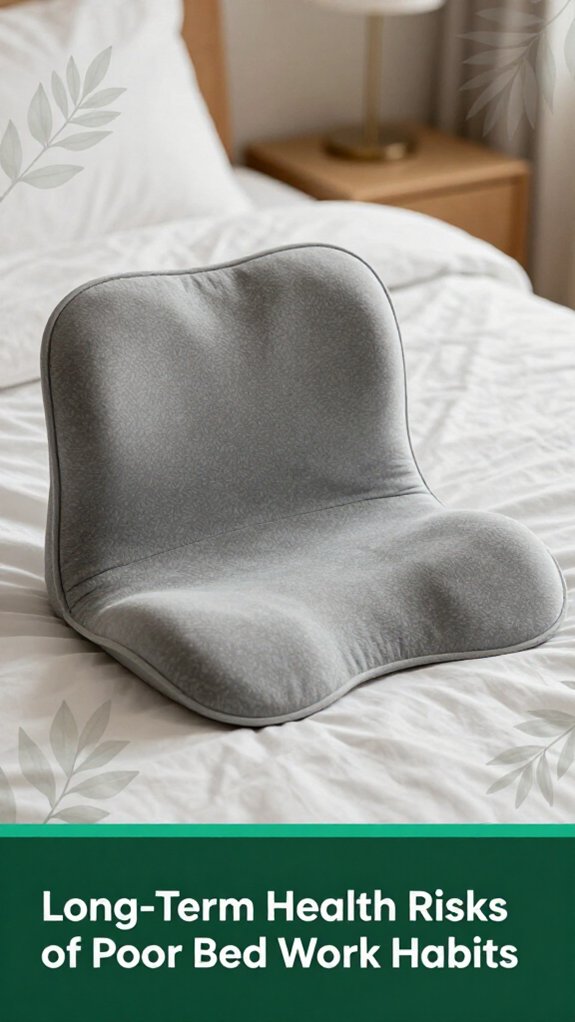
Long-term health risks from poor bed work habits can sneak up on you, similar to that slow drizzle that ruins a picnic without immediate notice. You might think, “It’s just a few hours,” but over time, your neck flexion from staring down at screens increases cervical disc pressure, which can lead to neck pain or herniation, according to research on spinal biomechanics.
A slumped lumbar spine on a soft mattress accelerates disc degeneration, particularly in the lumbar region, and sitting with knees bent tightens your hip flexors potentially causing lower back strain and contributing to conditions like sciatica.
Maintaining a static posture for extended periods also weakens your posterior muscles, including those in the paraspinal and gluteal regions, and can reduce bone density in the lumbar and femoral bones.
Sleep disruption, such as shortened sleep duration or irregular circadian rhythms, can increase stress levels and fatigue, which further exacerbate long-term health risks. Sleep disturbances may also be linked to poor posture during bed work, according to Mayo Clinic recommendations. Additionally, poor ergonomic support can lead to misalignments like thoracic kyphosis and sacral issues, amplifying long-term discomfort.
If you work or spend extended hours on your bed, be aware that poor ergonomic habits can contribute to thoracic kyphosis, cervical tension, and sacral misalignment, all of which may lead to chronic discomfort or musculoskeletal issues.
Adjusting your posture, using supportive pillows, and taking regular breaks from static positions are practical steps to mitigate these risks. Remember, your bed habits have a significant impact on your musculoskeletal health in the long run.
Yes, working in bed can cause permanent spinal damage. You’re likely to develop misalignments or disc degeneration from prolonged flexion, uneven weight, and lack of support, which your body can’t undo easily.
Think of your spine like a house you can patch up minor issues, but constant neglect will lead to serious, lasting damage.
You’ll probably start feeling that ache within just 30 minutes, maybe even less.
All right, think of your muscles like stretchy rubber bands when you hold bad posture, they get overstretched and tight, quickly. Neck flexion, unsupported wrists, hips tucked in that all adds up fast.
Before you know it, that dull, nagging pain is knocking at your door, and trust me, it’s way better to fix it before it becomes a full-blown saga.
You’re gonna want a good support, like a firm pillow or a contoured orthopedic one, to keep your back and neck in line.
Look for a portable bedside desk or a lap tray so you’re not awkwardly hunching or twisting.
You also need a cushion behind your lower back think wedge pillow to maintain that natural curve.
Basically, your goal is to mimic a proper chair setup without forcing your spine into bad angles.
Working on a mattress is like trying to type on a jellybean your mind struggles to focus, and your body pays the price.
All right, your muscles have to work extra just to keep you upright, which drains mental energy like a leaky faucet. Micro-movements interrupt your neural flow, and discomfort sparks stress hormones that make it harder to stay sharp.
Basically, your brain’s fighting a losing battle, and productivity suffers.
Yes, bed ergonomics can mess with your sleep long-term. When you work or lounge with poor support, your spine and neck don’t stay aligned that constant strain adds up, causing stiffness, pain, and even arthritis down the line.
I’ve learned that using proper pillows, changing positions often, and avoiding long work stretches in bed actually help you sleep better, feel less achy, and keep your back happy for years to come.
Look, if you keep working in bed like it’s your personal office, your back might just stage a full-blown rebellion. But here’s the truth: you don’t have to suffer through it. By adjusting your posture, using the right tools, and being mindful of how your body feels, you’re opening the door to a pain-free future you know, like that mythical land where your back doesn’t scream every time you stand up. You got this!