Physical Address
304 North Cardinal St.
Dorchester Center, MA 02124
Physical Address
304 North Cardinal St.
Dorchester Center, MA 02124

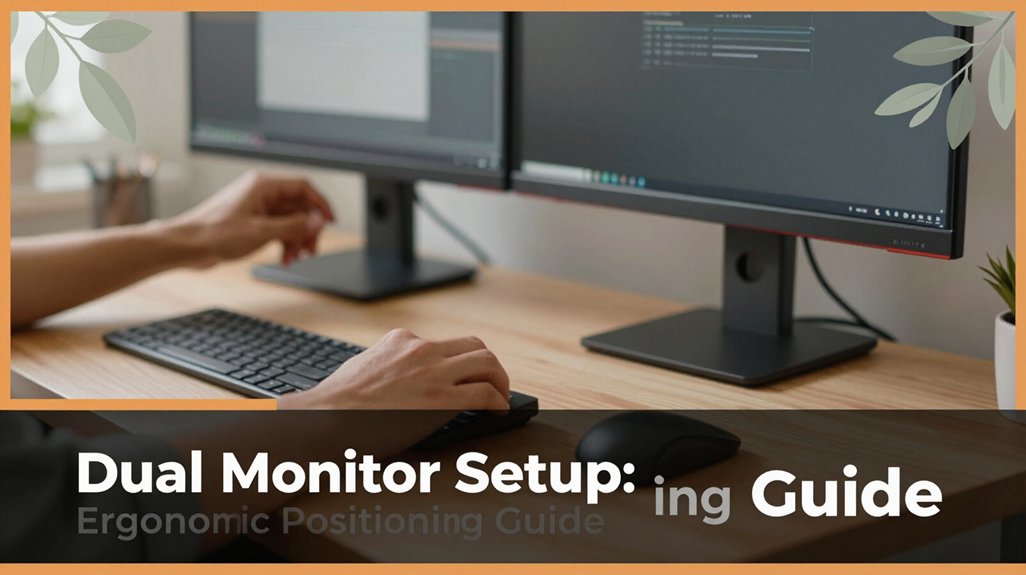
If you’re sitting in front of dual monitors all day, you’ve probably noticed that neck or shoulder ache creeping in after a few hours. Keep your monitors at eye level no craning or leaning and tilt them slightly down so your natural line of sight matches the screen.
Make sure they’re close enough about 20 to 30 inches to avoid eye strain, and align them to prevent neck twisting. Use ergonomic accessories like footrests and wrist supports, and if you want to stay comfortable longer, there’s more to optimize just keep going.
This article contains affiliate links. If you purchase through them, I may earn a small commission at no extra cost to you. I only recommend products I genuinely believe in.
Have you ever noticed how your neck or shoulders start to ache after a few hours at your desk, even though you’re just trying to do your job? That’s where a good dual monitor ergonomic setup comes in. When your monitors aren’t positioned correctly, your body compensates, leading to strain.
You might tilt your head or twist your torso, which seems minor but adds up fast. The key is to keep both screens at eye level, so you don’t crane or look down all day.
Keeping both screens at eye level prevents craning and reduces daily strain.
Highlight: The top of each monitor screen should be at or just below your eye level.
Lower the monitor to just below eye level, because looking slightly down is less fatiguing on the cervical spine than looking straight ahead or upward.
Position each monitor approximately 20 to 30 inches from your face, maintaining a comfortable viewing distance that prevents eye strain.
Step 1: Adjust the height of each monitor until the top of the screen is at or just below your eye level, because this reduces neck extension and strain.
Step 2: Set the monitors symmetrically to face directly forward, minimizing the need to twist your neck or torso.
Step 3: Ensure both monitors are at the same height and angle to prevent uneven head or neck tilting, because inconsistent positioning can cause muscle imbalances and discomfort.
Additional tip: Proper monitor placement helps maintain good ergonomic standards for a safe and healthy workstation.
Common mistakes:
Good ergonomics support your body by preventing discomfort during extended use because nobody wants to feel like a hunched turtle by mid-afternoon.
Proper setup keeps you comfortable, focused, and more productive throughout your workday.
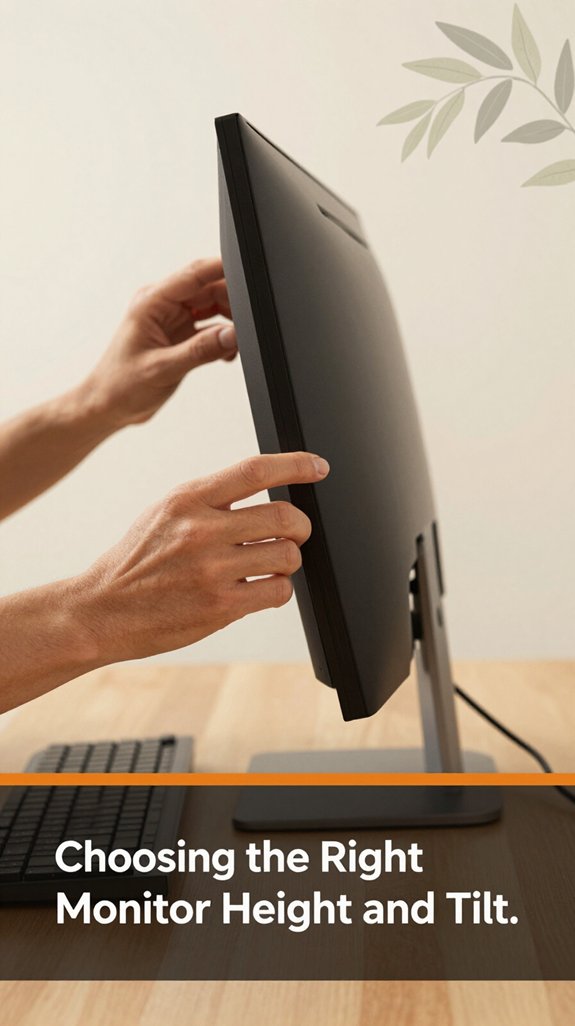
When you’re setting your monitor height and tilt, it’s all about aligning things so you don’t have to hold up a tiny flag every time you want to see clearly. Think of it as giving your neck and eyes a comfy seat. You want the top of the screen to be roughly at eye level no craning or looking down like a detective.
Set the monitor height so that the top of the screen is at or just below your eye level, because this reduces neck strain and keeps your head in a neutral position. To ensure optimal positioning, consider using a measurement formula that accounts for your specific desk and chair height, helping you find the perfect setup.
Tilt the monitor so the screen’s slight angle matches your natural line of sight, preventing glare and lazy neck rolls. This means angling the screen approximately 10 to 20 degrees downward if you’re sitting upright, depending on your seating height.
Here are key feelings to focus on during adjustment:
Correct monitor positioning feels like giving your body a much-needed hug.
Specific facts:
Common mistakes to avoid:
You’re probably familiar with that familiar feeling of your neck tingling, or maybe even aching, after long hours at your desk, like your head is somehow off-kilter and fighting to stay upright.
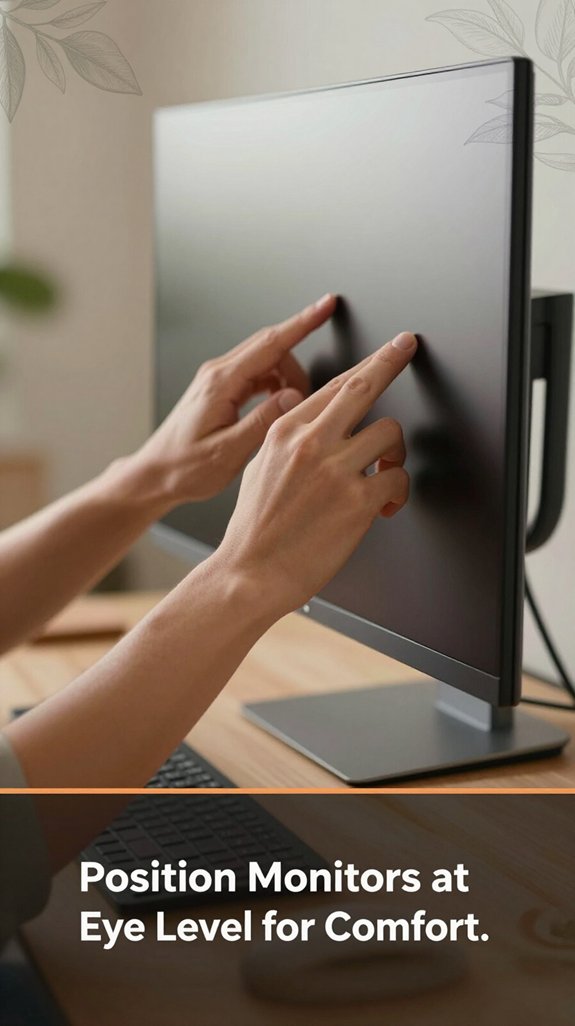
Now, here’s the thing: you want your monitors at eye level because that keeps your neck in a neutral position.
If you’re staring down or up, your neck muscles have to work extra hard, which leads to strain and fatigue you’ll feel later.
So, grab some books or a stand to raise your monitors until the top of the screen is just below your eye height. This adjustment gives your neck a break and reduces muscle strain, making your workspace more comfortable.
Specific Measurement Fact:
Raise the monitor until the top of the screen is at or just below your eye level. (For optimal comfort, the monitor should be positioned 20 to 30 inches from your eyes.)
Step-by-step Instructions:
Common Mistakes to Avoid:
*Remember:* Proper monitor height is essential for ergonomic comfort, reducing fatigue, and preventing long-term neck problems.
Adjust your setup today to prioritize your health.
On a long day at your desk, it’s almost certain you’ve caught yourself leaning in a little closer or falling back in your chair without even realizing it. That’s your body telling you something’s off. To fix it, align your monitors so they aren’t too close or too far.
Keep your monitors at about arm’s length approximately 20 to 30 inches from your face because this distance reduces eye strain and neck discomfort.
Position each monitor so they’re neither too forward nor too back, ideally within your comfortable field of view.
Highlighted Fact:
Optimal monitor distance: 20-30 inches from your eyes, because this reduces eye fatigue and promotes better posture.
Making these tiny tweaks such as adjusting your monitor’s distance, height, and angle can save your neck and your sanity.
Ensure the top of your monitor is at or just below eye level to avoid looking up or down excessively, which can cause neck strain over time.
Another important consideration is maintaining the correct monitor viewing distance, which can be calculated based on your screen size and resolution to optimize comfort and reduce strain.
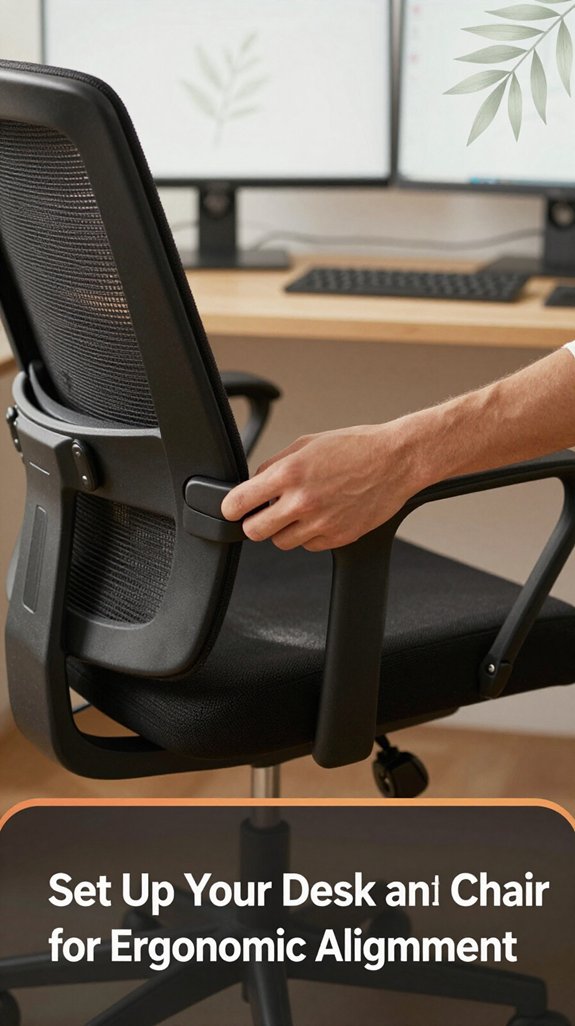
Did you know that the right desk and chair setup can completely change how your body feels after a long day? I’m sure you’ve noticed that neck ache that creeps in around hour three or that stiff lower back that insists on reminding you it’s still there.
Your chair should support your back’s natural curve and promote proper spinal alignment. Adjust the chair height so that your feet stay flat on the floor no dangling ankles. When seated, your knees should be approximately at a 90-degree angle or slightly more open, with thighs parallel to the ground.
Your desk height matters, too. Set your desk so that your elbows are bent at roughly a 90-degree angle when your hands rest on the surface because this position minimizes shoulder strain.
Key Measurement:
– Rest your elbows at approximately 90 degrees while your forearms are parallel to the ground, with a distance of about 1-2 inches between your wrists and the desk surface.
Adjust your monitor so that the top of the screen is at or just below eye level because looking slightly downward reduces strain on the cervical spine. Position the monitor approximately 20 to 30 inches from your face, ensuring clear visibility without leaning forward or squinting.
Take a moment to fine-tune your setup for comfort. If your body is fighting your setup all day, you’re engaging in a long haul with some major resistance. Think of it as giving your muscles a friendly pat instead of a tug-of-war, promoting better posture and reducing discomfort. Additionally, using a wrist rest properly can help maintain neutral wrist positioning and prevent strain during prolonged typing or mouse use.
Common Mistakes and Corrections:
– *Shoulders lifting or tensing up because the desk is too high.*
Set your desk height so your shoulders remain relaxed, with upper arms close to your sides.
– *Neck strain from looking up or down excessively.*
Align your monitor so the top aligns with your eye level, and avoid craning your neck to see the screen.
– *Feet dangling or unsupported.*
Ensure your feet are flat on the floor or on a footrest, maintaining proper leg support.
All right, now that you’ve got your chair and desk set just right, it’s time to think about your monitors. You want them positioned for easy keyboard and mouse access, so you’re not reaching or straining.
Imagine your arms hanging comfortably at your sides; your monitors should be right there, not off to the side or perched up too high.
Here’s what you should aim for:
Important Measurement:
– The optimal distance between your eyes and the monitor is 20 to 30 inches, roughly an arm’s length.
Trust me this setup keeps your neck and shoulders happy and saves you from that “why do I feel like I’ve been run over” feeling later.
A proper monitor placement not only improves your comfort but also promotes better ergonomics, reducing potential strain over time.
Common Mistakes and How to Fix Them:
Sometimes, no matter how perfectly you’ve set up your monitors, glare and reflections sneak in and make your screen look like it’s competing with your ceiling light for attention. It’s annoying, right? All right, here’s a quick fix: think about where your monitors are relative to windows and lights. Usually, turning your desk slightly away from bright sources helps a lot.
Check out this simple table:
| Tip | Why it Helps | Example |
|---|---|---|
| Move monitors perpendicular to windows or lights | Reduces direct reflections from bright sources because the monitor face is positioned to avoid direct glare | Turn monitors slightly sideways, about 15-30 degrees away from windows |
| Use matte screens | Diffuses reflections and reduces glare because matte surfaces scatter light instead of reflecting it directly | Invest in matte display filters compatible with your monitor model, like the Elite Screens Sable series |
| Adjust curtains and blinds | Blocks harsh light at key times because controlling ambient light reduces overall glare | Close blackout blinds during peak sunlight hours, typically between 10 AM and 4 PM |
Position your monitors so that the primary light source is not directly behind or in front of them.
*Fact:* Maintain a distance of 20 to 30 inches between your eyes and the monitor screen.
*Why:* This distance reduces eye strain and improves visual comfort.
Set your monitors so the top of the screen is at or just below your eye level.
*Why:* Looking slightly downward at your screen minimizes neck strain and decreases the likelihood of reflections bouncing into your eyes.
Apply matte display filters rated for your monitor size such as 3M Privacy Filters or Fellowes Premium Matte Screen Protectors to diffuse reflections further.
*Why:* Diffusion reduces harsh reflections and manages glare from overhead lighting or windows.
– Positioning monitors directly facing windows or light sources:
Why it’s wrong: Direct reflections cause glare, making it hard to see your screen.
Correct action: Rotate or reposition monitors perpendicular to windows.
– Using glossy screens in bright rooms:
Why it’s wrong: Glossy screens reflect ambient light, increasing glare.
Correct action: Switch to matte screen options or apply matte filters.
– Leaving curtains or blinds fully open during peak sunlight hours:
Why it’s wrong: Excessive ambient light creates competing reflections.
Correct action: Use curtains or blinds to block or diffuse sunlight at times of high visibility.
Implementing these precise adjustments will lower glare and reflections, making on-screen work more comfortable and protecting your eye health.
One of the simplest tweaks you can make to protect your eyes is adjusting your monitor’s brightness and color. Honestly, if your screen feels like staring into the sun after a few hours, it’s time to turn it down.
Brightness that’s too high causes eye strain, while too low makes you squint and lean in.
Adjusting color temperature to warmer tones can reduce blue light, which keeps your eyes from feeling like they’ve run a marathon.
Specific recommendations:
Note:
– If your monitor has a ‘Night Mode’ or ‘Blue Light Filter,’ enable it during evening hours to further protect your eyes and improve sleep quality.
Trust me, a simple tweak like this saves you from feeling like you’ve been marinating in fluorescent lights.
Here’s the thing: You spend hours in front of your screen, and your body starts to remind you that it’s not a fan of all that sitting and slouching. That’s where ergonomic accessories come in. You’ve probably seen those fancy wrist rests or foot pedals and wondered if they’re worth it spoiler, they are.
A good wrist rest, such as the Logitech Wrist Rest or Goldtouch Wrist Rest, minimizes strain on your wrists, preventing that annoying numbness or tingling. It provides a cushioned surface that encourages a neutral wrist position during typing or mouse use.
Footrests, like the Kensington SoleRest or Fellowes Earthlet Footrest, help keep your legs at a 90-degree angle, so your lower back isn’t fighting you all day. Proper positioning of the footrest prevents circulation issues and reduces lower limb fatigue.
Adjustable sit-stand desks, such as the Fully Jarvis or Uplift Desk, keep you out of “I’m about to fall asleep” slump mode for longer. For optimal ergonomics:
Vague instruction: “Adjust to a comfortable height” is unclear.
Specific measurement: “Raise the monitor until the top of the screen is at or just below your eye level.”
Common ergonomic mistakes to avoid:
In all, these small ergonomic accessories and proper positioning significantly improve comfort and reduce the risk of repetitive strain injuries. Your body will thank you.
When you start working on dual monitors, it’s easy to fall into some common traps that can turn your setup into a discomfort factory. You might’ve both screens at slightly different heights, forcing your neck to twist every time you look back and forth.
Or maybe your monitors are too close, causing you to lean forward and strain your eyes.
Here’s the thing:
Specific ergonomic recommendations:
All right, be kind to your body it deserves better.
Ever notice how your perfect setup starts to feel a little off after a few weeks? It’s easy to get comfortable, but your body doesn’t stay still. You might discover that your neck aches or your eyes feel strained more often, and that’s a sign to reassess.
All right, maybe your monitors shifted or your chair’s height needs tweaking. Now, don’t just “set it and forget it” your body changes, and so should your workspace.
Look for signs of discomfort and adjust your setup accordingly.
First, check your monitor placement. Raise the monitor until the top of the screen is at or just below your eye level because looking slightly down is less fatiguing on the cervical spine than looking straight ahead or upward.
Second, ensure your monitor distance is about 20 to 30 inches from your face because this range reduces eye strain and allows comfortable viewing without leaning forward.
Third, if your monitor arms need adjusting, loosen the joints and reposition each monitor so the screens are directly in front of you, not turned or tilted away, to avoid neck strain caused by turning your head.
Fourth, evaluate your chair height. Lower or raise your chair height so your feet rest flat on the floor, and your knees are at a 90-degree angle, supporting good circulation and posture.
Fifth, ensure your chair’s backrest supports your lumbar spine correctly. The backrest height and tilt should promote a natural curve in your lower back, preventing slouching and back pain.
Regular check-ins are essential because your body and workspace change over time. Think of it as tuning your car consistent adjustments keep everything running smoothly.
You wanna prevent neck strain with dual monitors? All right, start by aligning both screens so your eyes look straight ahead, not down or up.
Keep the monitors at about arm’s length, with the top at or just below eye level. Now, swivel them slightly inward no one wants to turn their whole body just to see the edges.
Take regular breaks, stretch, and stay mindful your neck will thank you.
You want your keyboard to be comfortable and prevent strain, right?
All right, first, place it so your elbows are close to your sides and your wrists stay straight no cocking up or down.
Now, keep your keyboard about even with your elbows, so your shoulders stay relaxed and your hands don’t hang awkwardly.
The goal? Minimize wrist flexion and stay within that “neutral” position, making typing feel almost effortless.
You should take a break every 20-30 minutes when using dual screens.
It’s like giving your eyes and back a mini-vacation they get tired, just like your legs after a long walk.
Look away from the screens, stretch your neck and arms, and stand up for a moment.
Trust me, that tiny pause keeps your body from turning into a stiff statue by the end of the day.
Your future self will thank you.
Absolutely, adjustable monitor arms can make a huge difference.
You know that feeling when your neck or eyes start protesting? That’s when you realize your monitors aren’t in the right spot. With arms that move easily, you can position your screens at eye level, close enough to see clearly without straining.
It’s like giving your neck a break makes your workspace feel more comfortable, and you’ll thank yourself later.
You want your monitors to avoid glare and eye strain, right?
The sweet spot is natural light, but avoid direct sunlight and harsh overhead bulbs.
Ideally, keep lighting soft and diffused, with your monitors positioned to minimize reflections.
If it’s too bright or dark, your eyes work extra hard, causing fatigue.
Alright, so wrapping up think of your dual monitor setup like tuning a guitar; if the strings aren’t just right, everything sounds off. When you get your monitors at eye level, aligned, and your chair supporting you, it’s like cueing that perfect harmony. You’ll notice the difference not just in your back and neck, but in how your brain feels less like a scrambled egg. Trust me, a few tweaks now make working for hours feel a lot less like a workout.