Physical Address
304 North Cardinal St.
Dorchester Center, MA 02124
Physical Address
304 North Cardinal St.
Dorchester Center, MA 02124

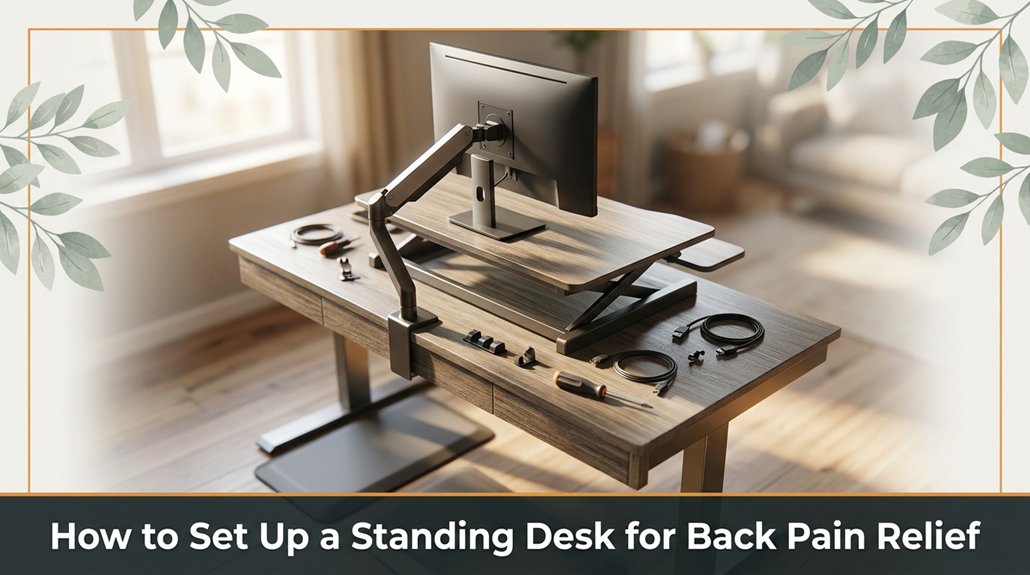
If your back is aching after long hours at your desk, setting up your standing workspace correctly can make a real difference. Here’s the deal stop your monitor so it’s directly in front of you, with the top edge 2-3 inches below your eye line, and about an arm’s length away. Your keyboard should be at elbow height, with your elbows bent at 90 degrees, and your mouse about 4-6 inches from it. Take it slow, gradually build your standing time, and make tiny tweaks raising the monitor a few millimeters or shifting your foot because those small moves can save your back in the long run. Keep at it, and you’ll start noticing the relief.
Alright, let’s get one thing straight first: no matter how fancy your standing desk is, if you don’t get it adjusted properly, you’ll be back to hunching under your laptop faster than you can say “ergonomics.” The key to comfort is finding that optimal height where your monitor is at eye level, your elbows are bent around a comfortable 90 degrees, and your wrists aren’t experiencing strain.
When setting up your standing desk to prevent back pain, focus on height adjustments that keep your shoulders relaxed and your upper arms close to your sides. Most adjustable standing desks have a range often from 24 inches to 50 inches so use it to find the position that feels most natural. It can feel like solving a Rubik’s Cube at first, but patience and small incremental tweaks are essential.
Adjust your desk height so shoulders stay relaxed and upper arms are close to your sides for comfortable, ergonomic support.
Remember, a good standing desk setup depends on precise adjustments, such as ensuring your monitor’s top edge is roughly at eye height, which is typically about 48 to 52 inches from the floor depending on your height. Making sure your ergonomic setup is correct will help prevent unnecessary strain.
Also, your keyboard and mouse should be positioned so that your forearms are parallel to the ground and your wrists stay straight, preventing strain.
Regularly reassess your position throughout the day: if your shoulders start to lift or your neck strains, it’s time to tweak the height or adjust your footwear or anti-fatigue mats.
Small, consistent steps in adjusting your setup will lead to significant relief from back pain and fatigue over time.
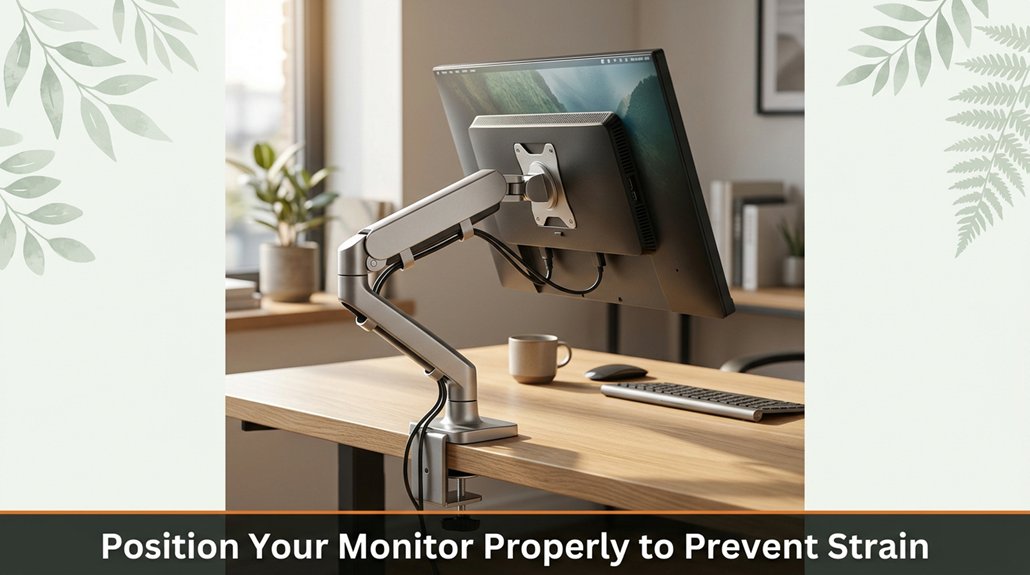
When it comes to positioning your monitor, it’s one of those tasks that seems simple until you spend 15 minutes adjusting the height and tilt just to get everything aligned correctly.
You pick up the monitor and try to set it at eye level, only to realize it’s not that straightforward because your workspace is unique.
Here’s the key: the top of your screen should be just below your eye level, approximately 2-3 inches (5-7.5 cm) below your natural gaze. This way, your eyes look slightly downward when viewing the screen, reducing neck and eye strain during extended periods of computer use.
Adjust the tilt so that the screen’s surface is perpendicular to your line of sight, meaning it should neither be tilted backward nor forward excessively.
The monitor should be directly in front of you, approximately 20 to 30 inches (50-75 cm) away, to prevent neck twisting and maintain a relaxed posture.
This positioning ensures that you’re viewing the display with minimal head movement, helping you avoid fatigue.
Remember, the goal is to establish a comfortable, ergonomic setup that prevents discomfort during long work sessions.
Once you find the ideal position, you can keep the monitor in place unless you decide to rearrange your workspace or move around frequently.
Proper monitor placement is a simple yet essential step toward maintaining your overall comfort and productivity. Proper eye level alignment
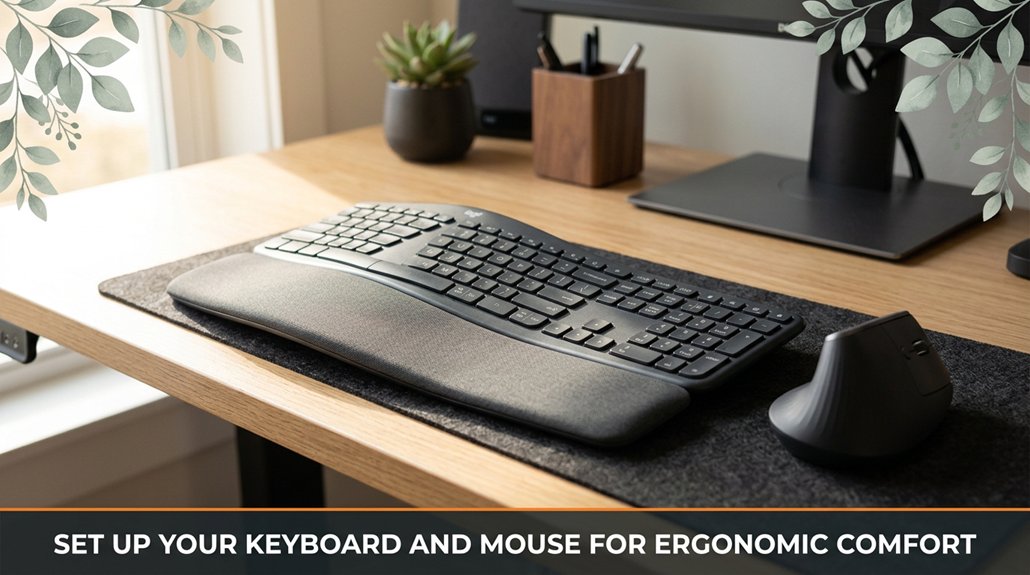
A keyboard and mouse might seem straightforward: plug them in, and you’re good to go, right? Well, not quite. For true ergonomic comfort, your keyboard should be positioned at elbow height, approximately 24 to 27 inches from the floor, so your arms rest naturally without shrugging your shoulders.
The mouse needs to be within easy reach about 4 to 6 inches from the keyboard so you don’t overreach or twist your wrist, which can cause strain over time.
Here are specific guidelines to optimize your setup:
Remember, adjusting your workstation may require some fine-tuning, but the ergonomic benefits less discomfort, reduced risk of repetitive strain injuries, and greater comfort during work are well worth the effort.
Once you set it up properly, maintaining these habits will become intuitive, and your ergonomic health will be protected over the long term.
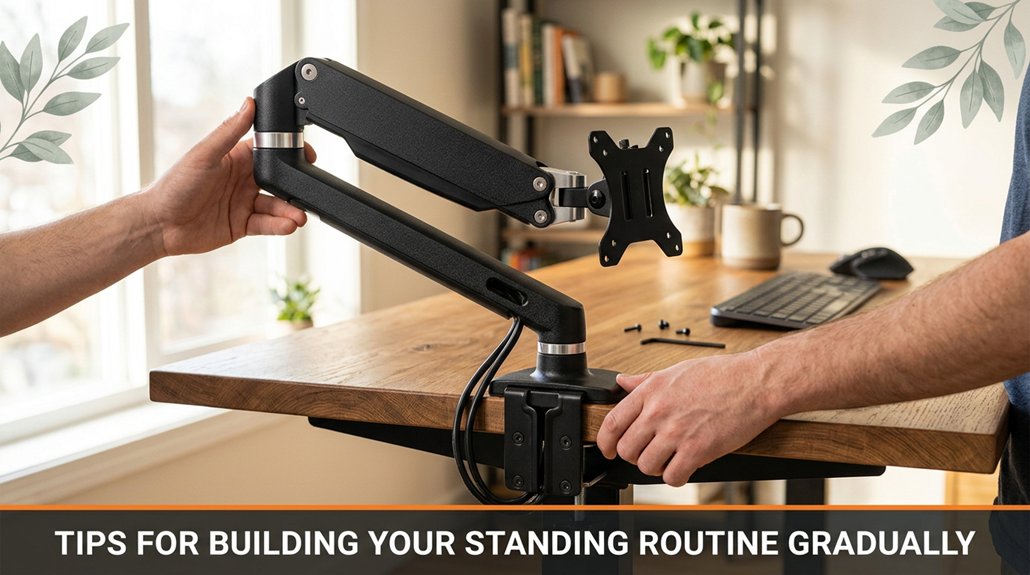
Building your standing routine doesn’t happen overnight. If you’ve ever been ten minutes into standing and felt like your legs are about to turn into jelly, wondering if this is supposed to be easier, you’re not alone.
Start slow by sitting for 20 minutes, then standing for 10 minutes. The next day, add five more minutes of standing. Your leg muscles and joints aren’t made of steel, and your body needs time to adapt to increased standing durations.
Avoid attempting to do too much at once, as that can lead to discomfort or hobbling around like a drunk centaur. Instead, follow a gradual progression.
If it takes longer than five days for you to feel comfortable standing for the desired duration, you’re on the right track.
Additionally, incorporating microbreaks of 2-3 minutes of activity every 20-30 minutes can help prevent discomfort and improve circulation during your standing routine.
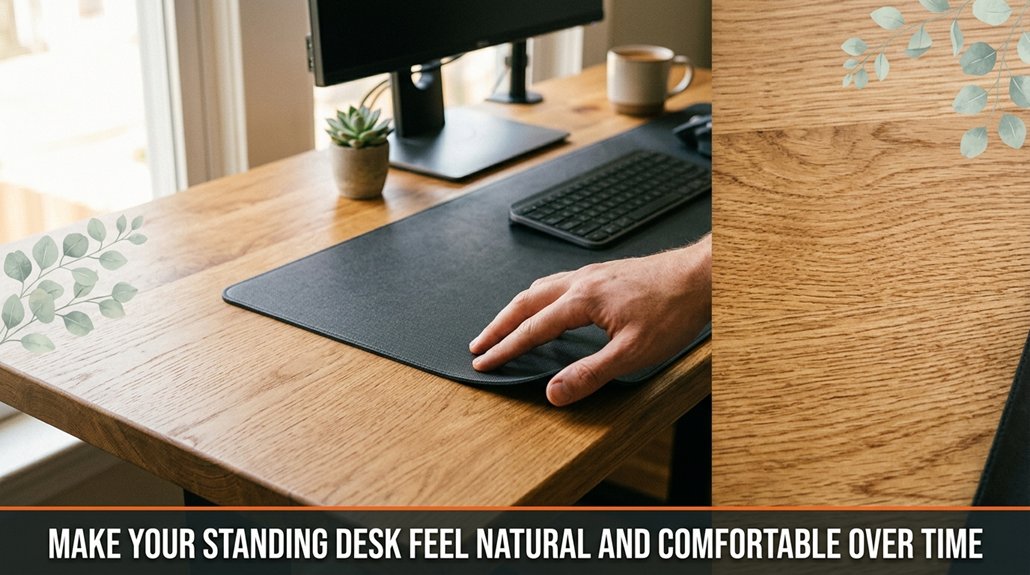
Your desk setup can feel surprisingly awkward at first like trying to sit on a chair that’s just a little off or wearing shoes that don’t quite fit. Honestly, that’s totally normal. To make it feel more natural over time, you need to fine-tune it regularly.
Adjust the desk height until your elbows form a 90-degree angle when your hands rest on the keyboard or work surface. This typically means setting your standing desk to approximately 42 inches high for an average-height adult, but adjust as needed for comfort.
Move your monitor to eye level, approximately 20 to 24 inches away, so you don’t have to crane your neck downward or upward, reducing strain on your cervical spine. Use a padded anti-fatigue standing mat, such as a 24-inch by 36-inch foam mat with a non-slip surface, to cushion your feet and prevent fatigue when standing for extended periods.
Keep shifting your weight or making slight movements every few minutes. This helps promote circulation and prevents stiffness and muscle fatigue in your lower back, legs, and shoulders. Incorporating correct monitor placement and positioning your keyboard and mouse properly can further enhance comfort and reduce strain.
Remember, don’t expect to get everything perfect overnight. Your body needs time to adapt, and it will tell you what adjustments are most comfortable.
Small tweaks like raising the monitor a few millimeters or adjusting your foot position can lead to significant relief over time.
Look, setting up your standing desk isn’t about finding the perfect position in 10 minutes trust me, I’ve been there. It’s about tweaking and listening to your back until it’s almost as comfortable as sitting, but without the slump. Stick with it, stay patient, and when you finally get it right, you’ll wonder why you didn’t do this months ago. Keep at it your back’s thanking you already.