Physical Address
304 North Cardinal St.
Dorchester Center, MA 02124
Physical Address
304 North Cardinal St.
Dorchester Center, MA 02124

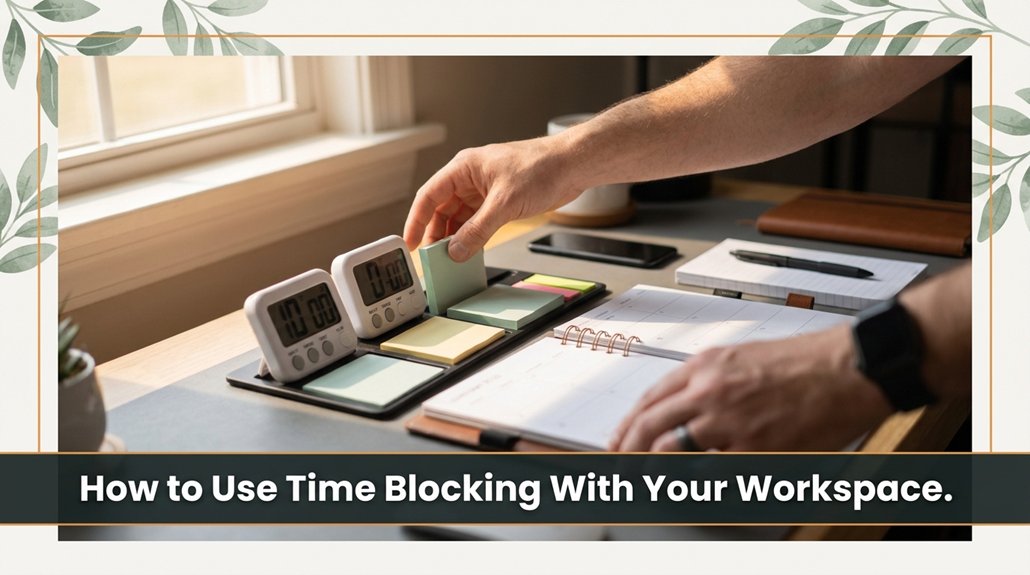
Struggling with a cluttered workspace that makes sticking to your time blocks tough? You’re not alone a messy environment can derail your focus faster than you’d think. Start by decluttering and carving out specific zones for deep work, quick tasks, and breaks, so your space naturally guides your attention. Keep essentials within arm’s reach and silence distractions like notifications and ringing phones trust me, they undo hours of prep. Make your setup ergonomic to avoid discomfort and help you stay in your zone longer. Follow these tips, and you’ll discover how a well-organized workspace genuinely makes your schedule more work-friendly.
This article contains affiliate links. If you purchase through them, I may earn a small commission at no extra cost to you. I only recommend products I genuinely believe in.
Look, I won’t sugarcoat it, setting up a distraction-free workspace can feel like trying to build IKEA furniture without the manual.
To conquer your time-blocking home office, start by decluttering because a tidy space minimizes visual distractions and fosters focus. Put away anything that doesn’t belong or is just noise.
Declutter your space to eliminate distractions and create a focused, productive environment.
Next, carve out a dedicated zone for work because having a specific area helps condition your brain to associate that space with productivity. Ensure this zone contains only work-related items like notebooks, pens, and your laptop, and avoid mixing laundry baskets or other household items in that area.
Choose a comfortable chair that supports proper posture and a desk with enough space for essentials ideally, a desk measuring 48 inches in width and 24 inches deep, so you have room to spread out without feeling cramped.
Now, consider your devices: silence notifications from your computer and turn off alerts on your phone because constant notifications break concentration. Keep your phone out of reach such as on a shelf or in a drawer because easy access tempts unnecessary checks that distract you from your task.
Remember, you’re creating an environment that’s tuned for focus and supports your time blocking so make it inviting and distraction-resistant. Adjusting your monitor to proper height based on ergonomic guidelines ensures better comfort and minimizes neck strain during your work sessions. This setup helps reinforce productive habits and reduces the likelihood of interruptions, making your work sessions more effective.

Ever wondered if your current workspace setup is actually helping or just there? Let’s check.
First, look around. Are your essentials within arm’s reach, or are you jumping up every five minutes? Because reaching for supplies across the room creates unnecessary interruptions and hampers workflow.
Second, assess your desk clutter. Clutter kills focus faster than a barking dog. Clear unnecessary items to establish a clean, organized surface that promotes concentration.
Third, evaluate your lighting. Is it dim or harsh? Neither helps productivity. For optimal lighting, use adjustable LED desk lamps like the BenQ e-Reading LED Lamp, setting the brightness to replace natural light without causing glare.
Fourth, think about your comfort. Adjust your chair height so your feet are flat on the floor, with knees at a 90-degree angle. Raise your monitor until the top of the screen is at or just below your eye level approximately 20 to 30 inches from your face.
Also, ensure your posture is upright, with shoulders relaxed and back supported. Incorporating ergonomic principles into your workspace setup can further enhance comfort and reduce strain. These may seem minor, but your back and focus will thank you.
Now, after doing a quick scan, ask yourself: is this space setting me up to work efficiently or distracting me? If your setup doesn’t support your habits, reconfigure it because an ergonomic workspace reduces fatigue and enhances productivity.
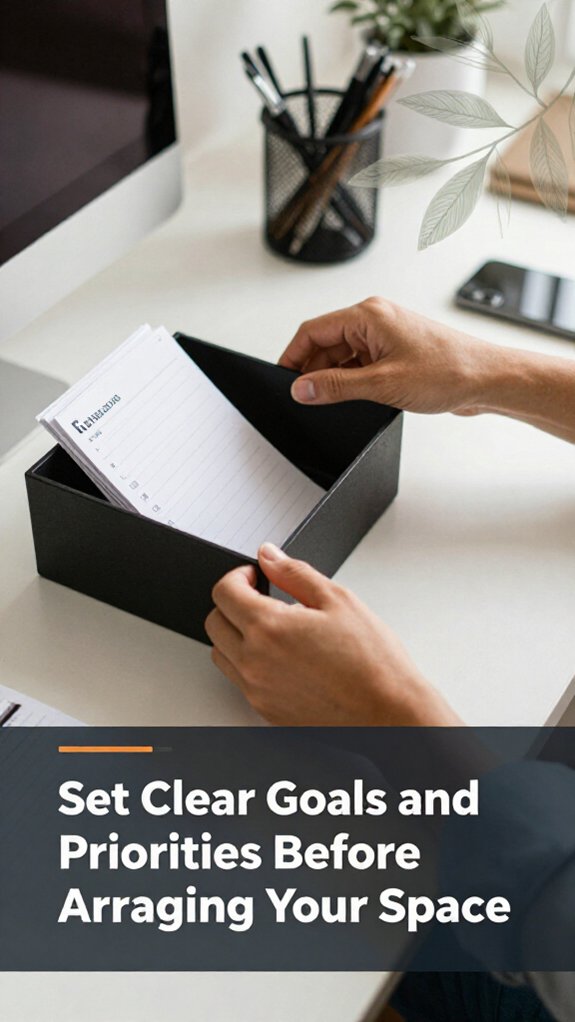
Before you start rearranging your workspace, you’ve got to get your goals straight literally. Think about what you actually need to get done. Are you focusing on deep work or quick email checks? Do you need space for calls or maybe a quiet corner? Write those priorities down because otherwise, your work zone will end up a jumble of everything and nothing.
Now, identify your most important tasks because that’s where your workspace’s purpose lies. If you’re unclear on what matters most, you’ll just keep shifting stuff around without any real flow. Remember, setting clear goals helps you decide what symbols of productivity to keep front and center.
Why setting goals helps:
It guides your organizational choices and prevents unnecessary re-rearranging later, saving you hours of chaos and frustration.
Specific guiding measurements to consider:
Common mistakes and how to avoid them:
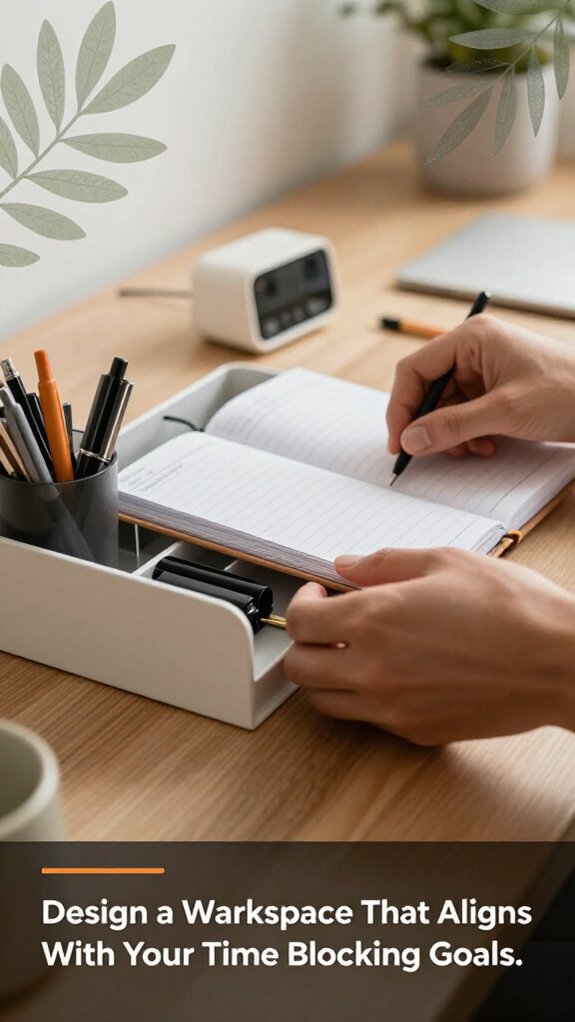
Designing a workspace that aligns with your time blocking goals is like crafting a custom suit nothing fits perfectly out of the box, and you’re better off tailoring it to your needs.
First, prioritize your tasks if your mornings are for deep work, create a quiet zone with minimal distractions, because uninterrupted focus enhances productivity.
Next, arrange your desk to support efficiency: keep your most-used tools within arm’s reach, not buried in a drawer, because quick access reduces unnecessary interruptions.
Arrange essentials within arm’s reach to boost efficiency and minimize interruptions.
Then, consider lighting; natural light boosts focus, while harsh fluorescent lighting can disrupt your rhythm.
Fact: Position your workspace near a window or in a well-lit area to maximize natural light; if this isn’t possible, use full-spectrum LED bulb lighting with a color temperature of 5000K to mimic daylight.
Add personalized touches that motivate you plants like pothos or succulents, artwork, or a beverage station because personal elements can improve mood and sustain your energy levels.
Tip: Place your favorite plants within 12 to 18 inches on your desk or shelf for easy viewing and care.
Proper workspace ergonomics and thoughtful layout are essential to support your time management strategies effectively.
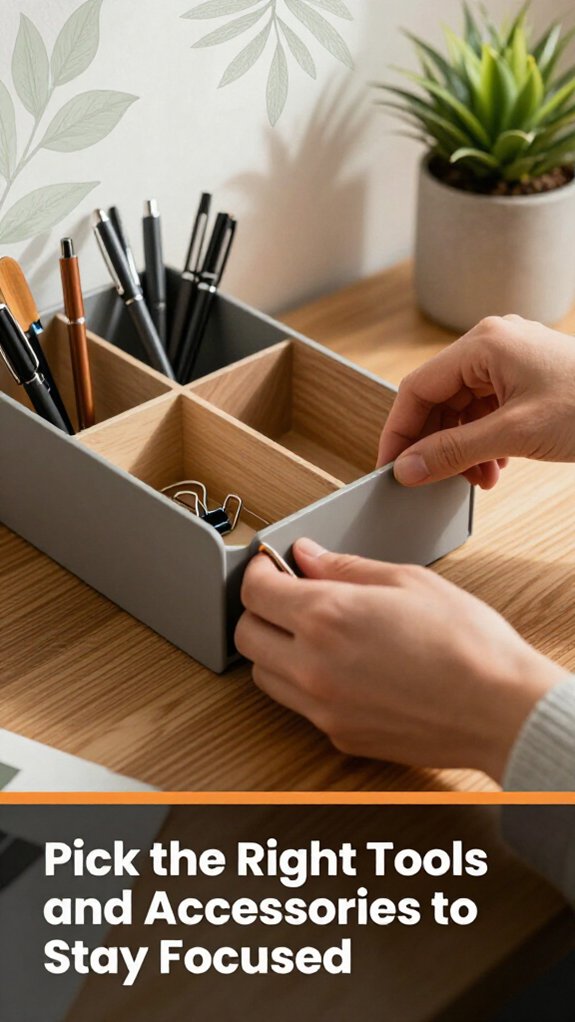
When it comes to staying focused, having the right tools and accessories in your workspace can make all the difference. Trust me, I’ve learned this the hard way after spending half an hour trying to adjust a monitor arm that refused to stay in place.
First, pick a good quality monitor arm that fits your desk and weight requirements because using a sturdy, well-made monitor arm prevents the frustration of constant readjustments. Measure your monitor’s weight and ensure the arm supports at least 20% more than that weight for stability.
Next, make sure you have a cable management kit because tangled cords can create visual clutter and distract you from work. Use cable clips, sleeves, or raceways to route cables neatly under the desk or along the monitor arm.
Look for noise-canceling headphones or earbuds, especially if you’re easily distracted by background noise. Choose headphones with an ANC (Active Noise Cancellation) feature to block out ambient sounds effectively.
Here’s the thing comfortable, ergonomic chairs and adjustable desks allow you to maintain focus longer because physical discomfort impairs concentration. Properly designed ergonomic features such as adjustable lumbar support and seat height help reduce strain and improve your overall comfort.
Adjust your chair so that your feet are flat on the floor, with knees at a 90-degree angle, and your lower back fully supported by the lumbar curve of the chair. Position your desk so that your elbows are at a 90 to 100-degree angle when typing, which minimizes strain.
Invest in a quality keyboard and mouse because cheap accessories cause fatigue and frustration that hamper productivity. A mechanical keyboard with tactile feedback, like the Logitech MX Mechanical, and an ergonomic mouse, such as the Logitech MX Master 3, can significantly improve comfort.
In the end, I promise, these tools save you time and mental energy, making your workspace more efficient and comfortable.
A cluttered desk can turn your entire day into a chaotic mess, so creating a visual schedule and mastering your calendar is like giving yourself a GPS in the wilderness. You need clarity, not guesswork.
First, pick a visual system such as whiteboards, sticky notes, or digital apps like Google Calendar or Microsoft Outlook and keep it simple because a clear system reduces confusion and enhances consistency.
Next, block out time for specific tasks, not just vague to-do lists because scheduling specific periods ensures each task receives adequate attention.
Use color coding urgent tasks in red, important tasks in yellow, low-priority tasks in green so you can spot your focus zones at a glance because visual cues speed up decision-making and task prioritization.
Synchronize your digital calendar across all devices smartphones, tablets, computers so you’re not chasing after appointments because this provides seamless access and reduces the chance of double-booking.
Review your schedule daily, adjusting as needed because life’s unpredictable and flexibility improves your follow-through.
Additionally, maintaining an ergonomic workspace such as positioning your monitor correctly can enhance your comfort and concentration during scheduling and task management because proper workstation configuration prevents chronic pain and injury.
Key Fixation Tip: Position the monitor so the top of the screen is at or just below eye level, with the monitor approximately 20 to 30 inches from your face, to reduce neck and eye strain.
All right, that’s your map. Follow it, and don’t forget to celebrate your small wins when everything stays on track, because acknowledging progress motivates consistent effort.
Let’s cut to the chase: setting up dedicated zones for different tasks isn’t just organizing your desk it’s about creating mental shortcuts that help you switch into the right headspace faster.
You need to carve out space for each work mode email, brainstorming, deep focus, whatever.
First, pick a corner or shelf for your deep work zone, and ensure it’s minimal and quiet to minimize distractions and promote concentration.
Choose a quiet, minimal spot dedicated to deep work to boost focus and reduce distractions.
Next, assign another spot for quick tasks like your notepad or charger.
Because having designated areas prevents clutter and confusion, it helps your brain recognize the current task mode effortlessly.
Distractions seem to have a knack for sneaking in when you’re deep in the zone, so the trick is to proactively shut them out before they get a chance. Stay focused by:
All right, set these up first because you’ll find it easier to dive deep into your work without constantly pulling yourself back from distraction.
Once you’ve set up your distraction blocking system, it’s time to think about how not to burn out halfway through your work session. Trust me, you’ll thank yourself when you’re not crashing two hours in.
Prioritize regular breaks to keep your focus sharp and prevent burnout during work sessions.
Schedule break times brief ones, like five minutes every 25 minutes, because this helps maintain focus and prevent fatigue. Alternatively, include longer breaks, such as a quick walk after every hour, which allows physical movement and mental reset.
You need those pauses to stretch, reset, or just stare blankly at your snack stash.
Fact: For optimal comfort and concentration, take a break approximately every 25 minutes for five minutes or every hour for at least 10 minutes.
Now, don’t just stick to a rigid clock be flexible. If a task hits a snag, shift your breaks accordingly, because adapting to your workflow prevents frustration and supports productive pacing.
Your brain isn’t a machine, and forcing it to run nonstop is like trying to run a marathon on expired energy drinks, which quickly leads to burnout and decreased efficiency.
Breaks keep you sharp, focused, and way less likely to yell at your monitor.
Imagine your workspace as the foundation of your productivity. Get this right, and everything else falls into place. First, clear clutter because nothing kills focus like a mountain of papers and empty coffee cups. Keep essentials within arm’s reach, but don’t let your desk turn into a storage unit.
Lighting is key because natural light boosts mood and reduces eye strain. If natural light isn’t an option, use a desk lamp with adjustable brightness, such as the BenQ e-Reading LED Lamp, to simulate daylight. Position the lamp to minimize glare on your screen.
Finally, minimize distractions by turning off notifications, closing unnecessary tabs, and creating a dedicated zone just for work. This helps your brain associate that space with focus and productivity.
Ensure your monitor is positioned at eye level because raising or lowering it can reduce neck strain and improve concentration. A good rule is to align the top of your monitor screen with your eye level and keep the monitor 20 to 30 inches from your face.
For example, positioning your monitor at eye level isn’t just about comfort; it maintains proper posture and reduces fatigue. Lower the monitor until the top of the screen is just at or slightly below your eye level.
Adjust your chair height if necessary, so your feet are flat on the floor and knees are at a 90-degree angle.
A spreadsheet, a notes app, or even a simple journal they’re all great tools for tracking your progress, and trust me, you’ll want to start.
You need to record what you’re doing and when because if you don’t capture your data, you’re guessing at best. Track how long each task takes, note when your energy dips, and mark days when you hop between time blocks.
All right, don’t aim for perfection just be consistent.
After a week or two, review your logs. You’ll notice trends: what actually works versus what you think should work. Use that information to tweak your schedule cut the fluff and double down on what helps you focus.
It’s not magic; it’s data, and it’s your new best friend.
Specific tracking actions:
1. Record the duration of each task, because understanding how long activities take helps optimize your schedule.
2. Note when your energy dips during the day, because this informs better task placement.
3. Mark days when you switch between different time blocks, because this reveals patterns in your productivity.
Review and improve:
4. After one week, analyze your logs to identify trends.
5. Adjust your schedule based on your findings by removing unnecessary tasks that don’t contribute to your goals.
6. Focus more on activities that improve your focus, as indicated by your data.
Ergonomic tip:
Position your monitor so the top of the screen is at or just below your eye level, approximately 20-30 inches from your face, to reduce neck strain during extended work sessions.
Highlighted fact:
Monitor height formula: Top of screen at or just below eye level, with a distance of 20 to 30 inches from your face.
Building consistent workspace habits is the secret sauce to making your time blocking actually work for you. Suppose you want your workspace to signal, “Now it’s focus time.” Here’s how:
Establishing consistent workspace habits signals when it’s focus time, helping your time blocking become truly effective.
Highlight Fact:
Position the monitor 20 to 30 inches from your face.
Detailed Steps:
You should reassess your workspace about every three to six months. I know, it sounds like forever, but your needs–like your work habits and tech–change faster than you think.
All right, maybe every three months if you’re switching projects or adding gear, and closer to six if things feel comfortable but not quite optimized.
Trust me, it’s worth catching small issues before they turn into productivity killers like that crammed drawer you keep avoiding.
Yes, remote or hybrid work environments can totally implement time blocking, but here’s the catch you have to be intentional.
You’ll need a dedicated workspace no distractions, no thinking, “Maybe I’ll check my email real quick.” Use digital calendars or tools, block out specific hours, and stick to them.
All right, it’s not perfect the first week, but you’ll thank yourself when your focus sharpens.
Think of workspace mistakes like trying to fit a square peg in a round hole frustrating and doomed from the start.
You’re probably cluttering your desk, ignoring ergonomic setup, or letting distractions creep in because you didn’t define clear zones or minimize interruptions.
All right, you’ve got to keep your space tidy, position your tools for easy access, and set boundaries otherwise, your time-blocking efforts will fall apart faster than you can say “multitasking.”
You personalize your workspace by adding elements that actually inspire you no, not just that generic plant everyone has.
Pick meaningful decor or photos that evoke motivation. Adjust your chair and monitor height so you’re comfortable, because obvious? Poor posture kills focus.
Use colors that energize you, but don’t go full neon unless that’s your vibe. Remember, this is your zone make it the place you actually want to work.
You’ll notice your workspace needs a complete redesign when clutter suddenly feels overwhelming, your focus drops faster than that disastrous DIY project, or you keep hitting your head on the same problem.
I’m sure you’ve been 45 minutes into rearranging when you realize the chair still isn’t right.
All right, if you’re hating your setup, it’s probably time to rethink everything your comfort, flow, and how much junk actually belongs there.
Alright, you’ve set up your workspace and now you’re ready to conquer your day. Remember, it’s like tuning a guitar you tweak a little here, adjust a little there, and soon you’re playing your best. Keep tracking your progress; don’t be surprised if your ideal setup takes a few tries. Most importantly, stay flexible because even the best plans still need a little improvisation. Now go ahead, make that space work for you.