Physical Address
304 North Cardinal St.
Dorchester Center, MA 02124
Physical Address
304 North Cardinal St.
Dorchester Center, MA 02124

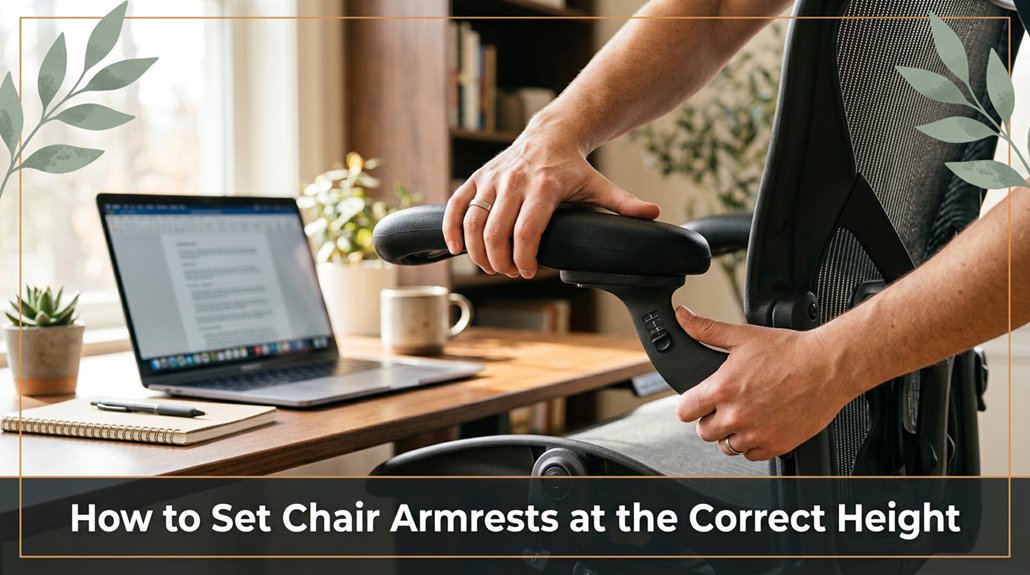
Setting your chair armrests at the right height might seem straightforward, but it can actually be pretty tricky to get just right. If your shoulders start to tense up or your elbows feel uncomfortable while working, you’re not alone and adjusting these can make a big difference.
First, sit back comfortably and relax your shoulders no tension. Then, measure your elbow height when your arms are resting naturally at your sides. Raise or lower the armrests until your elbows form about a 90-degree angle, mirroring how your joints naturally want to sit.
The goal? Keep your forearms parallel to the ground and your shoulders relaxed. Once you get the hang of it, you’ll see how simple it is to find the perfect fit every time.
This article contains affiliate links. If you purchase through them, I may earn a small commission at no extra cost to you. I only recommend products I genuinely believe in.
You know that feeling when you finally sit down at your desk after all the fiddling and realize your armrests are doing more harm than good? That’s why armrest height adjustment matters for your posture.
Proper armrest adjustment prevents discomfort and promotes better posture at your desk.
If your armrests are too high, you’ll shrug your shoulders constantly, inviting tension. If they’re too low, you’ll push yourself forward or lean awkwardly. The correct armrest height supports your elbows close to your sides, forming roughly a 90-degree angle.
Proper Armrest Height Formula:
Armrest height should be set so that your elbows are at a 90-degree angle when your shoulders are relaxed, with your forearms parallel to the ground.
Maintaining this alignment helps keep your shoulders relaxed without forcing them up or down, reducing strain and fatigue. It’s also important to remember that regularly adjusting your office chair settings can help prevent discomfort over time.
Most people assume they can just set the armrest height once and forget it. However, minor adjustments can significantly impact your comfort and posture.
Adjustment Tips:
Common Mistakes and Correct Practices:
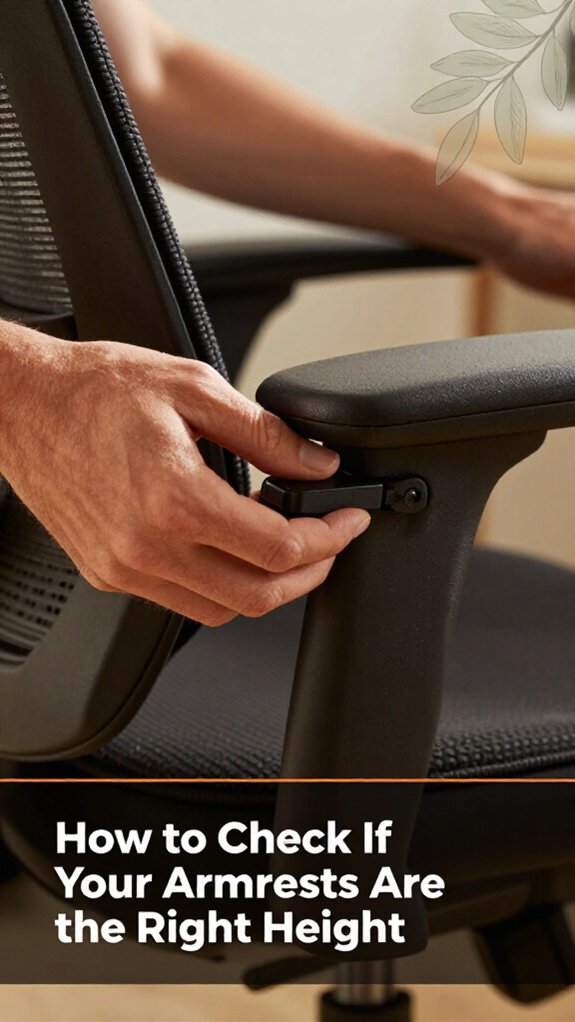
Ever wonder if your armrests are doing their job, or just adding to your tension? I’m sure you’ve sat there, arms on your desk, and thought, “Are these the right height?” Here’s how to check.
First, sit back comfortably, with your shoulders relaxed because maintaining a relaxed shoulder position reduces muscle strain and promotes proper ergonomics.
Rest your arms naturally on the armrests. Your elbows should be roughly at a 90-degree angle because this position minimizes strain on your shoulders and neck.
Ensure your elbows aren’t higher than your shoulders, as this causes shrugging and muscle tension. Conversely, if your elbows are lower than your shoulders, you might be reaching down and straining your back or shoulders.
Next, look at your arm position relative to your desk. If your elbows aren’t aligned with your desk surface or keyboard, your armrests probably aren’t right.
The goal is to keep your shoulders relaxed and your arms supported not scrunched or dangling.
Measurement Tip: Your armrests should be adjustable to match the height of your elbows when seated comfortably. The ideal armrest height is where your elbows are at approximately 90 degrees, and your forearms are parallel to the ground.
Additional Tips:
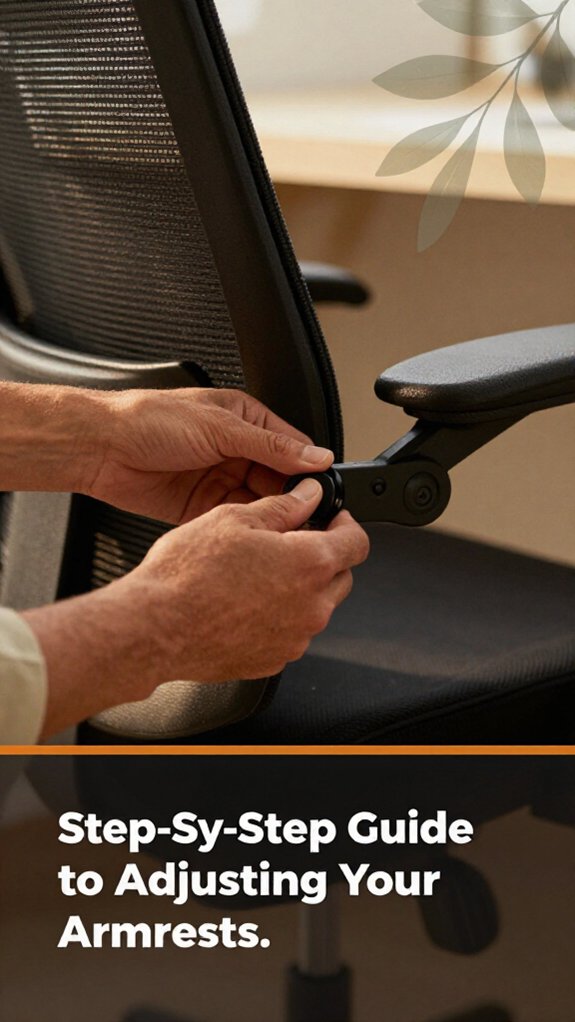
Adjusting your armrests is usually straightforward, if you know what to do. Here’s a quick step-by-step guide to get those armrests at just the right height:
All right, it’s tempting to rush, but make sure it’s secure. Why? Because minor movements can become a major annoyance if they slip during a meeting.
Important measurement fact:
– Position the armrest so that your elbows rest comfortably at about a 90-degree angle, with your forearms parallel to the floor.
Additionally, ensuring your armrests are ergonomically adjusted helps prevent shoulder strain and promotes better posture during long periods of sitting.
Now, sit back, test it out, and make adjustments if needed. Trust me, a little patience now saves twitchy arms later.
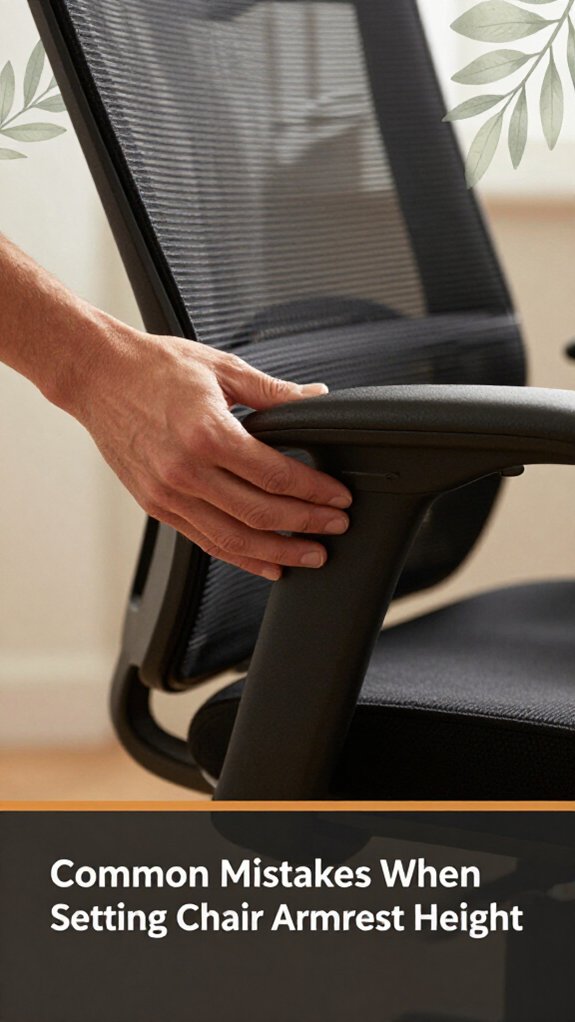
One of the biggest mistakes people make when setting chair armrest height is assuming that they can just eyeball it and call it a day. You sit down, think, “That looks close enough,” and bite the bullet. Spoiler: it’s rarely close enough. Your shoulders end up tense, your elbows crooked, and suddenly, you’re fighting an ergonomic battle you never signed up for.
Here’s the thing: your goal is to keep your arms relaxed and your shoulders level not scrunched or stretched. Adjust the height so that your forearms are roughly parallel to the ground because this position promotes natural shoulder alignment and reduces muscle strain.
Don’t settle for “close enough,” because over time, small misalignments turn into neck and back pain.
To achieve proper armrest height:
Important fact:
– Your forearms should be approximately 90 degrees at the elbows, with the upper arms relaxed and close to your torso.
Avoid the mistake of setting armrests too high, which can elevate your shoulders and cause tension, or too low, which leaves your arms unsupported and leads to fatigue.
Proper adjustment prevents chronic discomfort and promotes better ergonomic health over the long term.
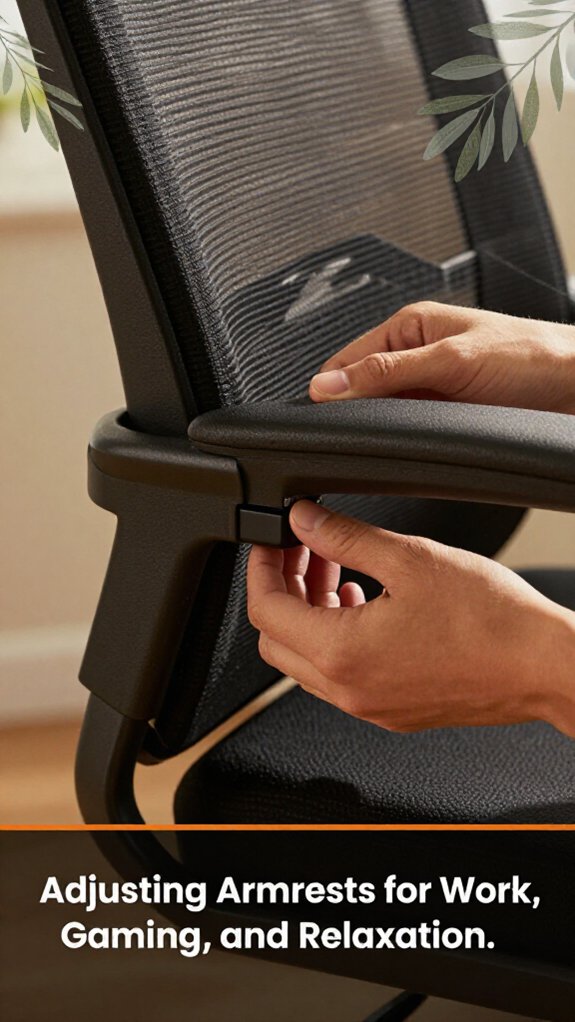
The first thing to realize is that adjusting your armrests isn’t a one-size-fits-all deal, because what works for gaming mightn’t be ideal for writing reports, and both are different from kicking back with a book.
When you’re customizing your armrests to fit your body, don’t just set it and forget it, because fine-tuning is key. You might think, “That looks good,” but then spend four hours adjusting later that day.
Start by testing your arm position because proper alignment reduces strain and increases comfort. You want your elbows at a 90-degree angle, relaxed, not scrunched up or stretched out.
Elbow height = the height of your seated elbow when your arm is resting comfortably at your side.
Now, if your armrests are adjustable, tweak the height until your forearms are parallel to the ground because this position promotes neutral shoulder alignment.
Adjust the armrest height to match your seated elbow height, so the forearms are parallel to the ground.
Here’s the thing everyone’s body is different, so these measurements are guidelines, not absolute rules. Make small adjustments, then sit for a few minutes.
Feel your shoulders; are they tense or loose? If your shoulders are tense, lower or raise the armrests accordingly because excessive shoulder tension indicates the armrests aren’t properly aligned.
Additionally, check that your chair’s adjustable features support proper posture and comfort, especially considering ergonomic design benefits such as lumbar support and breathability in materials.
Absolutely, armrest height can impact shoulder strain over time.
Studies show poor ergonomics cause about 20% of workplace discomfort. You want your arms relaxed at your sides, elbows bent at roughly 90 degrees, and your shoulders hanging naturally.
If armrests are too high or low, you’ll hunch or reach, straining those muscles. I’ve seen it happen just a tiny tweak can save your shoulders months later. Trust me, it’s worth it.
You can use adjustable armrests with office chairs, ergonomic gaming chairs, and even some conference or task chairs.
Seriously, look for those with a height adjustment lever or dial.
All right, check the specs before you buy if the manufacturer lists “adjustable,” that’s your signal.
Just be aware: not all furniture frames support the mechanism, so make sure your chair’s construction is compatible, or you’ll be sweating for nothing.
You should recheck your armrest height every few months, especially if you notice discomfort or your setup changes think of it like tuning a guitar; if it’s off, everything sounds wrong.
I’m sure you’ve been 45 minutes into work when you realize your armrests feel awkward, and you’re adjusting for the third time.
Regular checks keep things comfy and prevent that “why does this hurt?” moment from creeping up.
Yes, there are ergonomic standards, but don’t expect a strict rulebook.
Basically, your armrests should be at a height where your shoulders stay relaxed, and your elbows form about a 90-degree angle.
All right, you want them to support your arms comfortably without pushing your shoulders up or forcing you to slump.
It’s about finding that sweet spot where you feel supported but not restrained.
Believe me, your back will thank you.
To adjust fixed armrests, you’ll need an Allen wrench or screwdriver depending on your chair. I swear, fixing armrests usually takes longer than assembling the whole chair.
All right, find the adjustment screws beneath or on the side. Loosen them slightly. Don’t over-tighten, or you’ll strip the threads.
Push or lift the armrest to your preferred height, then tighten. Easy? Well, not always sometimes, those screws are tighter than your patience.
Look, setting those armrests just right isn’t rocket science, but it’s easy to forget that comfort and posture are worth a few minutes of fiddling. Trust me, once you get it dialed in, you’ll wonder why you ever settled for that tilted, awkward armrest. Remember, it’s not about perfect perfection it’s about ending the long, boring battle with your setup and actually feeling good at your desk. Cheers to finally getting those armrests right!